
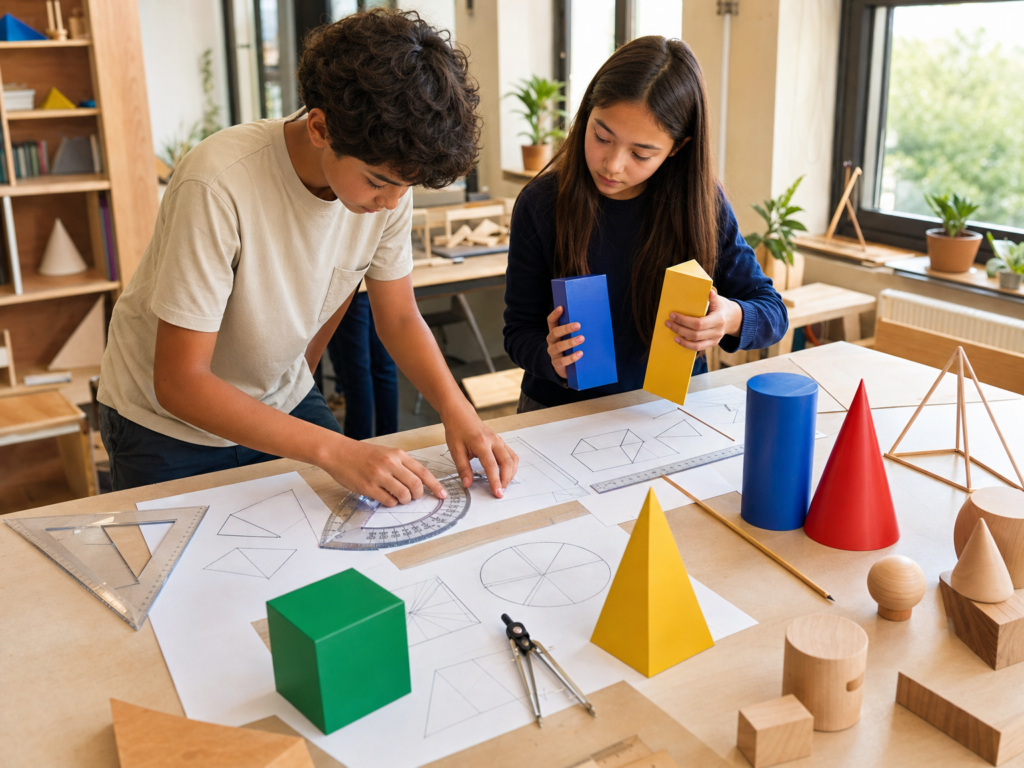
Geometry practice can feel surprisingly different from the math children have already learned.
A learner may be comfortable with addition, multiplication, and even fractions, then suddenly encounter angles, parallel lines, three-dimensional figures, area, perimeter, and unfamiliar vocabulary. Instead of simply calculating an answer, the child is now expected to interpret diagrams, recognize relationships, visualize shapes, and decide which information matters.
That change can make a capable math learner feel as though the rules have suddenly changed.
The encouraging part is that geometry becomes much more manageable when children can see it, touch it, measure it, draw it, and connect it to objects they already understand.
Rather than treating geometry as a collection of formulas to memorize, effective geometry practice helps learners develop spatial understanding first. Once the ideas make sense visually, the calculations become much easier to understand.
Here are eight practical ways parents and homeschool families can help.
1. Start Geometry Practice With Real Objects
Geometry is everywhere, which gives parents an advantage that is not always available with other areas of math.
Before asking a learner to identify a rectangular prism on a worksheet, find one in the room.
A cereal box, book, tissue box, or shipping carton can become a rectangular prism. A soup can illustrates a cylinder. A ball provides an easy introduction to a sphere.
Ask simple questions:
What shape does this object resemble?
How many faces can you find?
Which faces are rectangles?
Does it have edges?
Can it roll?
Can it stack?
These conversations turn abstract vocabulary into something concrete.
For younger learners especially, handling actual objects helps establish meaning before formal definitions are introduced.
2. Make Geometry Vocabulary Visual
Geometry introduces a large amount of new language.
Terms such as vertex, parallel, perpendicular, acute, obtuse, congruent, diameter, radius, prism, and symmetry can become overwhelming when they are learned only as definitions.
Instead, connect each new word to a picture or physical example.
If the learner is studying parallel lines, look for them in railroad tracks, notebook paper, shelving, or floorboards.
For perpendicular lines, examine the corner of a picture frame or where a wall meets the floor.
When learning radius and diameter, draw a large circle and physically trace each measurement.
The goal is not simply to remember what a word means long enough to pass a quiz. The learner should eventually be able to recognize the concept without needing the definition repeated.
A simple geometry vocabulary notebook can help. Give each concept its own page with the term, a short definition, a drawing, and a real-world example.
3. Draw Shapes Instead of Only Looking at Them
Recognizing a shape and constructing one require different levels of understanding.
A child may easily point to a parallelogram but struggle to draw one accurately. That struggle can actually be useful.
Drawing forces learners to think about the properties that define a figure.
Provide rulers, graph paper, protractors, and pencils and encourage children to construct shapes themselves.
Try challenges such as:
Draw a quadrilateral with exactly one pair of parallel sides.
Draw two different rectangles with the same perimeter.
Create three triangles that look different but all contain a right angle.
Draw a shape with one line of symmetry, then another with two.
These activities move geometry practice beyond identification and into reasoning.
The drawings do not need to be perfect. What matters is that learners begin thinking about why a shape qualifies as a particular geometric figure.
4. Teach Area and Perimeter as Different Ideas
Area and perimeter are frequently confused because they are often taught together.
The formulas may look simple, but the concepts describe two completely different things.
Perimeter measures the distance around something.
Area measures the space inside it.
Before introducing formulas, make that distinction physical.
Imagine a rectangular garden. A fence around the garden represents perimeter. Grass covering the ground represents area.
Or place a book on a sheet of paper. Trace around its edge to represent perimeter. Then imagine covering the entire front of the book with square tiles to represent area.
Once the distinction is clear, formulas such as length × width have a reason to exist rather than becoming another rule to memorize.
When learners have difficulty deciding what a problem is asking them to find, the challenge may also involve interpreting the language of the problem.
You can reinforce the idea by asking children to find examples around the house. Which situations require measuring around something? Which require knowing how much surface must be covered?
That simple question builds mathematical judgment.
5. Let Learners Measure Angles Before Memorizing Them
Angles are another area where hands-on geometry practice can make a major difference.
Before expecting a learner to identify 35°, 90°, or 125°, build an intuitive understanding of how angles open and close.
Two pencils can become rays. Hold their ends together and gradually move one pencil.
Ask:
Is the angle getting larger or smaller?
Can you make a right angle?
Can you create an angle smaller than a right angle?
Can you make one larger?
Then introduce the vocabulary:
Acute angles are smaller than 90°.
Right angles measure 90°.
Obtuse angles are larger than 90° but smaller than 180°.
Once learners understand what those categories look like, introduce the protractor.
Initially, focus on using the tool correctly rather than speed. Protractors can be confusing because they display two sets of numbers. Give children time to determine which scale makes sense based on whether the angle is acute or obtuse.
Understanding should come before fluency.
6. Use Geometry Practice to Develop Spatial Reasoning
Some geometry difficulties are not really calculation problems at all. They are visualization problems.
A learner may need to imagine a shape rotating, picture how a net folds into a solid, recognize the same figure in a different orientation, or determine how several smaller shapes combine into a larger one.
These skills improve with experience.
Tangrams, pattern blocks, building bricks, puzzles, geometric solids, and paper folding can all strengthen spatial reasoning.
Try asking a child to predict what will happen before physically moving an object.
What will this shape look like if we rotate it?
Which two pieces could combine to make a rectangle?
Which net do you think will fold into a cube?
Can you build the same structure in a different way?
Activities like these may feel like play, but they develop the visualization skills that later geometry depends upon.
7. Connect Geometry to Everyday Decisions
Geometry becomes more meaningful when children understand why people use it.
Suppose you want to place a rug in a bedroom. You need to understand dimensions and area.
If you are building a picture frame, you need accurate lengths and angles.
Painting a wall requires estimating surface area.
Designing a garden involves shapes, perimeter, area, and measurement.
Even rearranging furniture requires spatial reasoning.
Ask learners to help with simple real-world measurement projects. Measure a tabletop. Estimate whether a bookshelf will fit into a particular space. Calculate how much border would be needed to go around a poster.
The objective is not to turn every household task into a math lesson. It is to occasionally demonstrate that geometry describes the physical world children interact with every day.
That realization can make practice feel considerably more purposeful.
8. Build Geometry Skills in Small Steps
Geometry includes many related concepts, and trying to master too many of them simultaneously can create unnecessary frustration.
A better approach is focused practice.
A learner might spend several short sessions working specifically on angle recognition before measuring angles. Area and perimeter can be practiced separately before mixed problems require deciding which measurement is needed.
The same principle applies to shapes, transformations, coordinate geometry, and three-dimensional figures.
Short, focused geometry practice also makes it easier to identify where confusion begins.
If a learner struggles with the area of a triangle, for example, the problem might not be multiplication. The learner may not understand base and height. More general practice will not necessarily solve that specific misunderstanding.
Targeted practice makes the difficulty easier to see and address.
This is also where printable practice can be especially useful. A well-designed worksheet can isolate one skill, provide enough repetition to develop confidence, and allow the learner to work through each step without unrelated distractions.
What to Do When Geometry Still Feels Difficult
If a child continues struggling, resist the temptation to immediately increase the number of problems.
First determine what kind of difficulty the learner is having.
Does the child understand the vocabulary?
Can the learner interpret the diagram?
Is measurement causing the problem?
Does the child know which formula applies?
Is the arithmetic correct but the geometric reasoning wrong?
Can the learner explain what the answer represents?
Those questions can reveal much more than another page of mixed problems.
Sometimes the best response is to move backward temporarily. Return to a physical model, redraw the diagram, use graph paper, or work through one example slowly.
That is not lost progress.
It is often exactly what allows progress to resume.
Geometry Practice Should Build Understanding Before Speed
There is a time for fluency in geometry, but speed should not be the first goal.
A learner who understands why a formula works is in a much stronger position than one who can quickly substitute numbers into it without understanding what those numbers represent.
Encourage children to draw diagrams, label measurements, estimate answers, and explain their reasoning.
Ask questions such as:
What do you already know?
What are you trying to find?
Which measurements matter?
What does your answer represent?
Does the answer seem reasonable?
These habits strengthen more than geometry. They develop mathematical reasoning that transfers to algebra, word problems, measurement, and more advanced mathematics.
Learners who would benefit from additional instruction and practice can also explore Khan Academy’s Basic Geometry and Measurement resources, which cover topics including area, perimeter, angles, three-dimensional figures, and geometric transformations.
Geometry can initially seem difficult because it asks learners to think about mathematics in a new way. But that difference is also what makes geometry valuable.
With hands-on exploration, clear visuals, focused geometry practice, and enough time to understand each concept, shapes and formulas begin to become something more useful: a way of understanding the world around us.
Continue Exploring Math Help & Guidance
Explore more Math Help & Guidance from Encouraging Math for practical strategies, teaching ideas, and clear explanations designed to make math easier to understand and practice.