
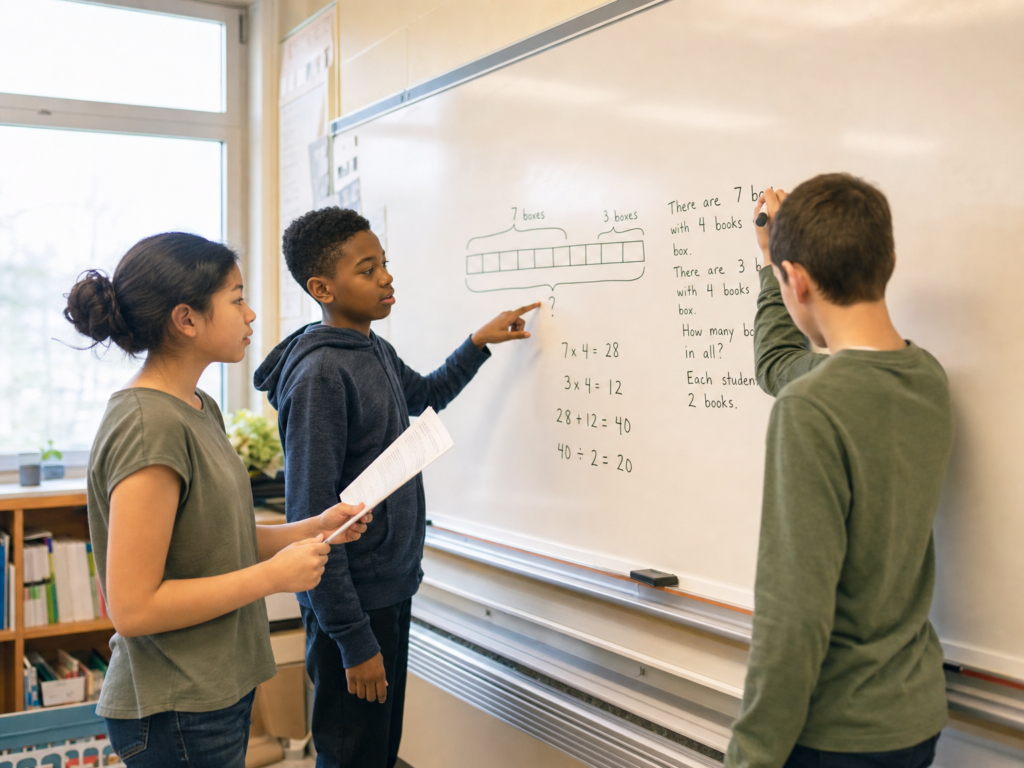
Math word problems can frustrate learners who otherwise seem perfectly capable of doing the math.
A child may know addition facts, understand multiplication, or successfully divide numbers on a worksheet. Then the same skills appear inside a paragraph, and suddenly the learner is unsure what to do.
The difficulty is often not the calculation itself.
Math word problems require learners to understand a situation, decide which information matters, determine which mathematical operation applies, and then solve the problem accurately.
That is a lot of thinking packed into a few sentences.
For parents and homeschool families, the goal should not be teaching children to hunt for a particular keyword and immediately perform an operation. A better approach is helping learners develop a repeatable process for understanding what a problem is actually asking.
Here are eight practical ways to make math word problems clearer and more manageable.
Why Math Word Problems Can Be So Difficult
A standard computation problem gives the learner a fairly direct instruction:
36 ÷ 4 = ?
The operation has already been selected. The learner simply needs to calculate the answer.
A word problem is different:
A teacher has 36 pencils and divides them equally among 4 groups. How many pencils does each group receive?
The arithmetic has not changed. The thinking required before the arithmetic has.
The learner must recognize that:
- there are 36 total pencils
- they are being separated into 4 equal groups
- the question asks for the amount in each group
- division is the appropriate operation
Only then can the learner calculate 36 ÷ 4.
For a child who is still developing reading comprehension, number sense, fact fluency, or mathematical reasoning, those extra decisions can make a simple problem feel much harder.
1. Start by Asking What the Problem Wants to Know
Before reaching for a pencil, encourage the learner to identify the actual question.
Ask:
“What are we trying to find?”
This small habit can dramatically improve how a learner approaches math word problems.
Children sometimes begin calculating as soon as they see numbers. They may add two numbers simply because both appear in the problem.
Instead, have the learner restate the question in their own words.
For example:
There are 24 students going on a field trip. Each van holds 6 students. How many vans are needed?
A learner might say:
“I need to find how many groups of 6 can be made from 24.”
Now the mathematical structure becomes much clearer.
2. Separate Important Information From Extra Information
Not every word or number in a word problem is necessarily important.
Consider this example:
Emma has 18 blue beads and 12 red beads. She bought them on Saturday and wants to divide all the beads equally among 5 bracelets. How many beads will go on each bracelet?
The fact that Emma bought the beads on Saturday does not affect the calculation.
Learners need practice distinguishing between:
information needed to solve the problem
and
information that simply provides context.
Have the learner underline or circle the numbers and facts that matter.
Then ask:
“Do we need this information to answer the question?”
This encourages active reading rather than simply scanning for numbers.
3. Understand the Situation Before Choosing an Operation
Children are sometimes taught shortcuts such as:
- “altogether” means addition
- “left” means subtraction
- “each” means multiplication
- “share” means division
These clues can occasionally help, but relying on them too heavily can create problems.
Words do not always point reliably to one operation.
Instead, ask what is happening in the situation.
Is something being:
- combined?
- separated?
- compared?
- repeated in equal groups?
- divided into equal groups?
- increased?
- decreased?
Understanding the relationship between the quantities is more useful than memorizing a list of trigger words.
This becomes increasingly important as math word problems grow more complex.
4. Draw the Problem
Some learners understand a situation much more easily once they can see it.
Suppose the problem says:
Four boxes contain 8 markers each. How many markers are there altogether?
The learner could draw four simple boxes and place eight dots in each one.
The picture makes the structure visible:
4 groups × 8 markers = 32 markers
Drawings do not need to be artistic.
Circles, tally marks, number lines, bars, arrays, boxes, and quick sketches can all help translate words into mathematics.
Visual models are especially valuable when a learner knows how to calculate but struggles to determine what calculation is needed.
5. Estimate Before Solving
Estimation gives learners a powerful way to check their reasoning.
Suppose a problem involves buying 6 notebooks for $4 each.
Before multiplying, ask:
“About how much should the answer be?”
The learner should recognize that the total will be somewhere around $24.
If the final calculation produces $2.40 or $240, that estimate provides an immediate warning that something probably went wrong.
Estimation helps children move beyond simply performing procedures.
They begin thinking about whether an answer is reasonable.
That is an important mathematical habit that becomes even more valuable as problems become more complicated.
6. Break Multi-Step Problems Into Smaller Problems
Multi-step math word problems can overwhelm learners because several decisions have to be held in mind at once.
Consider:
A family buys 4 packages of water. Each package contains 12 bottles. They drink 15 bottles during the weekend. How many bottles remain?
There are two separate tasks.
First:
4 × 12 = 48 bottles
Then:
48 − 15 = 33 bottles
Instead of asking the learner to solve everything at once, ask:
“What can we figure out first?”
After solving that part, ask:
“What do we know now?”
Then move to the next step.
This approach reduces cognitive overload and teaches learners that complicated problems are often just a series of manageable smaller problems.
7. Require the Learner to Explain the Answer
A correct number does not always mean the learner understood the problem.
After solving, ask:
“What does your answer mean?”
If the learner calculated 33 in the previous example, the complete answer is not simply:
33
It is:
33 bottles remain.
This encourages the learner to reconnect the calculation with the original situation.
Explaining an answer also makes it easier to spot mistakes.
If the child cannot explain what the number represents, there may still be confusion about the problem.
8. Use Short, Consistent Word Problem Practice
More practice is not always better practice.
A learner struggling with math word problems may become discouraged by a worksheet containing 30 unfamiliar problems.
Instead, begin with a small number of carefully chosen problems.
Three or four problems solved thoughtfully can be more valuable than twenty problems completed with guessing and frustration.
Keep the difficulty appropriate to the learner’s current skills.
If the goal is learning how to interpret word problems, the arithmetic itself should initially be comfortable.
Once the learner becomes more confident with the process, gradually introduce more challenging calculations and multi-step situations.
Consistency matters more than volume.
A Simple Math Word Problem Routine
Learners often benefit from having the same process available every time they encounter a problem.
Try this five-step routine:
1. Read.
What is happening?
2. Identify.
What am I trying to find?
3. Plan.
What operation or strategy makes sense?
4. Solve.
Work carefully and show the steps.
5. Check.
Does the answer make sense?
The routine should eventually become familiar enough that the learner begins using it independently.
That independence is the real goal.
Careless errors can also interfere with otherwise strong math work, especially when learners rush through multiple steps.
What Parents Should Do When a Learner Gets Stuck
It is tempting to immediately explain which operation to use.
Instead, try asking questions that help the learner uncover the structure of the problem.
Ask:
“What do you already know?”
“What are you trying to find?”
“Could you draw what is happening?”
“What could we figure out first?”
“Does this remind you of another problem you have solved?”
These questions provide support without taking over the thinking.
If the learner remains stuck, simplify the numbers while keeping the same problem structure.
For example, instead of:
72 cookies are divided equally among 8 children.
try:
12 cookies are divided equally among 3 children.
Once the learner understands the structure with easier numbers, return to the original problem.
When the Real Problem Is Fact Fluency
Sometimes a child understands the word problem perfectly but struggles because basic calculations require too much effort.
A learner may correctly determine that a problem requires multiplication but then spend so much mental energy trying to remember 7 × 8 that the larger reasoning process becomes difficult to maintain.
In that situation, the solution is not necessarily more word-problem instruction.
Strengthening basic fact recall may make the entire process easier.
This is one reason foundational skills and mathematical reasoning should develop together.
Additional word problem practice can help learners become more comfortable translating everyday situations into mathematical operations.
Printed Worksheets Can Help Learners Slow Down
Digital math tools can be useful, particularly for quick repetition and immediate feedback.
Printed math word problems offer a different advantage.
Learners can:
- underline the question
- circle important numbers
- cross out irrelevant information
- draw a model beside the problem
- write each calculation
- erase and reconsider a step
- check their reasoning before moving on
The worksheet becomes a visible record of the learner’s thinking.
For children who tend to rush or guess, that can be especially valuable.
Progress Comes From Understanding the Process
A learner does not become confident with math word problems simply by completing more of them.
Confidence develops when the process starts making sense.
The child begins recognizing what a problem is asking.
Important information becomes easier to identify.
Choosing an operation becomes less mysterious.
Multi-step problems become a sequence of smaller decisions rather than one intimidating task.
And answers begin to mean something rather than simply appearing at the bottom of the page.
The goal is not speed.
The goal is helping learners develop a reliable way to think through unfamiliar problems.
Once that process becomes familiar, math word problems become far less intimidating.
Keep Building Math Confidence
If your learner struggles with math word problems, begin with a few manageable problems and focus on the reasoning rather than the number completed.
Encourage your learner to read carefully, identify the question, draw when helpful, show the work, and check whether the final answer makes sense.
Small improvements in these habits can create meaningful progress over time.
Encouraging Math is designed to support that process with clear guidance and focused printable practice that helps learners strengthen skills one step at a time.
Continue Exploring Math Help & Guidance
Explore more Math Help & Guidance from Encouraging Math for practical strategies, teaching ideas, and clear explanations designed to make math easier to understand and practice.