
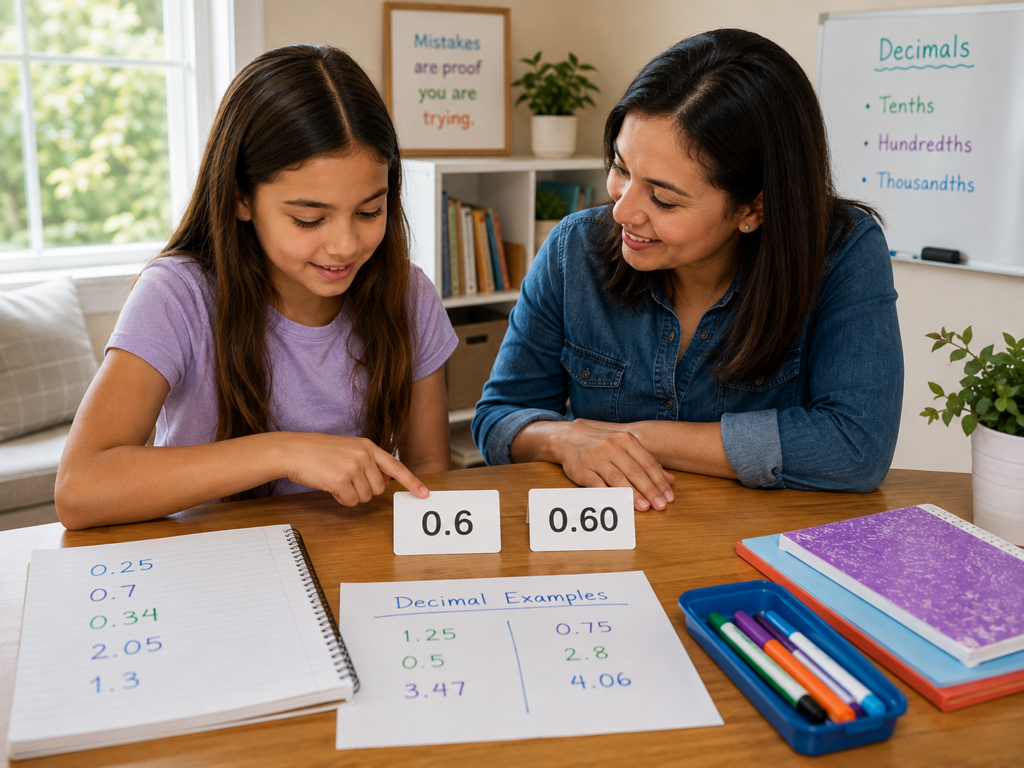
Decimal practice can become frustrating when a learner understands whole numbers but suddenly struggles when a decimal point appears.
That confusion makes sense.
For years, children learn that larger digits generally represent larger amounts. They become comfortable with ones, tens, hundreds, and thousands. Then decimals extend place value in the opposite direction, introducing tenths, hundredths, and eventually thousandths.
A learner may look at 0.25 and 0.7 and assume that 0.25 must be larger because 25 is larger than 7.
The problem is not necessarily calculation. The learner may simply need a clearer understanding of what decimal numbers represent.
Effective decimal practice should help children see the quantities behind the numbers before expecting them to memorize procedures.
Here are eight practical ways parents and homeschool families can make decimals easier to understand and practice.
1. Start Decimal Practice With Place Value
Before asking a learner to add, subtract, multiply, or divide decimals, make sure the underlying place-value concept is solid.
Consider these numbers:
0.5
0.05
0.005
The digit 5 appears in every number, but its value changes because of its position.
In 0.5, the 5 represents five tenths.
In 0.05, it represents five hundredths.
In 0.005, it represents five thousandths.
A place-value chart can make these differences much easier to see.
Encourage your learner to write numbers into columns labeled ones, tenths, hundredths, and thousandths. This turns the decimal point from an arbitrary-looking mark into a boundary between whole-number places and fractional places.
This foundation becomes increasingly important as decimal problems become more complicated.
2. Connect Decimals to Money
Money provides one of the easiest real-life introductions to decimals because children may already understand dollars and cents.
One dollar can be written as:
$1.00
Half a dollar is:
$0.50
One quarter of a dollar is:
$0.25
Ten cents is:
$0.10
Now a decimal such as 0.25 is no longer merely two digits following a decimal point. It represents twenty-five hundredths of a whole dollar.
Try giving your learner several prices and asking questions such as:
Which costs more, $0.75 or $0.50?
How much more?
What two amounts could you combine to make $1.00?
How would you write 35 cents as a decimal?
Everyday experiences can make abstract math concepts considerably more concrete.
3. Use Visual Models Before Relying on Rules
Some learners understand decimals much faster when they can see them.
A 10-by-10 grid is particularly useful. The entire grid represents one whole, while each of the 100 smaller squares represents one hundredth.
Shade 25 squares.
The learner can see 25/100 and connect that quantity to 0.25.
Shade 70 squares.
Now compare 0.70 with 0.25.
This is especially helpful for the common misconception that 0.25 must be larger because 25 is greater than 7.
Writing the numbers as 0.25 and 0.70 also makes the place values easier to compare.
Visual models help learners understand why the comparison works instead of simply memorizing a rule.
Learners who would benefit from additional examples can also explore Khan Academy’s decimal lessons and practice activities for more work with decimal concepts.
4. Put Decimals on a Number Line
Number lines provide another powerful way to make decimal values visible.
Draw a line from 0 to 1.
Place 0.5 halfway between them.
Then add 0.25 and 0.75.
Ask:
Which decimal is closest to zero?
Which is closest to one?
Where would 0.1 belong?
Where would 0.9 belong?
What number would be halfway between 0.4 and 0.6?
Once learners become comfortable with tenths, you can introduce hundredths and larger ranges.
Number lines reinforce an important idea: decimals are numbers with actual positions and values, not simply strings of digits separated by a point.
5. Read Decimal Numbers for Meaning
How decimals are spoken can reinforce place value.
Instead of always reading 3.7 as “three point seven,” occasionally read it as:
Three and seven tenths.
Read 2.35 as:
Two and thirty-five hundredths.
This language connects the written number directly to place value.
You can turn this into a simple activity.
Write several decimals on cards and have your learner read each one aloud. Then reverse the exercise. Say a decimal in words and have the learner write the number.
For example:
“Six and four tenths.”
The learner writes:
6.4
Then try:
“Six and four hundredths.”
The learner writes:
6.04
That small difference can reveal very quickly whether the learner understands place value.
6. Use Short, Focused Decimal Worksheets
More problems do not automatically produce more learning.
A learner who is still developing decimal understanding may gain more from ten carefully selected problems than from a worksheet containing fifty repetitive calculations.
The purpose of a worksheet should be clear.
One page might focus on identifying place value.
Another might compare decimals.
Another might practice ordering decimals from least to greatest.
Later pages can introduce computation.
This progression allows learners to concentrate on one skill at a time.
Shorter practice sessions can also make it easier to notice why an answer was incorrect.
Was the decimal point misplaced?
Were the place values misaligned?
Did the learner compare the digits as whole numbers?
Did they misunderstand the operation?
A mistake can provide useful information when there is enough time to examine it.
7. Bring Decimal Practice Into Everyday Activities
Decimals become easier to understand when children encounter them outside a worksheet.
Fortunately, decimals are everywhere.
Shopping
Compare prices such as $2.49 and $2.79.
Ask which is greater and by how much.
Measurement
Measure objects using metric units and record results with decimals.
Cooking
Discuss measurements such as 0.5 liters or 1.5 cups when appropriate.
Sports
Compare race times such as 12.8 seconds and 13.2 seconds.
Which time is faster?
Weather
Look at rainfall totals or temperatures that include decimal values.
These activities help learners discover that decimals are not merely something they encounter during math practice. They are a useful way of describing quantities in everyday life.
8. Ask Learners to Explain Their Thinking
One of the best ways to determine whether a child understands decimals is to ask for an explanation.
Consider:
Which is greater, 0.4 or 0.35?
A correct answer is useful.
An explanation is even more revealing.
A learner might say:
“0.4 is the same as 0.40. Forty hundredths is greater than thirty-five hundredths.”
That demonstrates understanding.
If the learner cannot explain the answer, return to a visual model, money example, place-value chart, or number line.
You can also intentionally give an incorrect statement:
“0.27 is greater than 0.5 because 27 is greater than 5.”
Ask the learner whether you are correct and why.
Explaining someone else’s mistake can be a surprisingly effective way to strengthen mathematical reasoning.
Common Decimal Mistakes to Watch For
Several mistakes appear frequently as learners develop decimal skills.
Comparing Decimals Like Whole Numbers
A learner may believe:
0.35 > 0.8
because 35 is greater than 8.
Rewrite the numbers as:
0.35
0.80
The comparison becomes much clearer.
Misaligning Numbers During Addition and Subtraction
When adding:
3.4 + 0.27
the numbers should be aligned by decimal place:
3.40
0.27
Keeping place values aligned is more important than simply lining up the final digits.
Adding Unnecessary Zeros Incorrectly
Learners should eventually understand that:
0.5 = 0.50 = 0.500
Adding zeros to the right of a decimal does not change its value.
This idea can make comparing decimal numbers much easier.
Rounding Without Understanding the Number
Rather than teaching rounding only as a memorized procedure, use a number line.
If a learner is rounding 3.7 to the nearest whole number, show where 3.7 lies between 3 and 4.
Seeing that it is closer to 4 gives the rounding rule meaning.
How Much Decimal Practice Does a Learner Need?
There is no single amount that works for every child.
A better question is:
What does the learner need to understand next?
If a child cannot compare 0.4 and 0.35 confidently, adding more complicated decimal multiplication may simply create frustration.
Return to the missing concept.
Use a place-value chart.
Draw a number line.
Use money.
Shade a decimal grid.
Then try the problem again.
Short, regular practice focused on the appropriate skill is often more productive than completing large numbers of problems simply for the sake of repetition.
When a Learner Keeps Struggling With Decimals
If decimal practice continues to be difficult, look backward before pushing forward.
Decimals depend heavily on earlier concepts, particularly place value and fractions.
Ask whether your learner understands:
- Ones, tens, hundreds, and thousands
- Tenths and hundredths
- Basic fractions
- Equivalent values
- Number lines
- Comparing quantities
Sometimes what appears to be a decimal problem is actually a gap in one of these earlier skills.
Similar difficulties can occur when learners move into other unfamiliar areas of math, which is why it helps to identify the specific concept causing confusion before simply increasing the amount of practice.
That is valuable information.
It tells you where practice should begin.
If your child is learning decimals at school and you are uncertain about the difficulty, communicating with the teacher can also help you understand what the class is currently working on and where additional practice at home may be most useful.
Building Confidence With Decimal Practice
Children do not need to master every decimal skill at once.
Start with understanding.
Then compare.
Then order.
Then calculate.
And gradually introduce more challenging applications.
A learner who understands why 0.7 is greater than 0.25 has developed something much more valuable than the ability to repeat a comparison rule.
They are developing number sense.
And that understanding provides a stronger foundation for percentages, measurement, algebra, and many of the math concepts still to come.
Frequently Asked Questions About Decimal Practice
When do children usually begin learning decimals?
Decimal concepts are generally introduced during elementary mathematics, although the exact timing varies by curriculum. Familiarity with money and fractions can give children an informal introduction even earlier.
Should children learn fractions before decimals?
Understanding basic fractions can make decimals considerably easier because the two concepts are closely connected. For example, recognizing that one half, 0.5, and 50/100 represent the same quantity strengthens number sense.
Why does my child think 0.25 is larger than 0.7?
The learner may be applying whole-number thinking and comparing 25 with 7. Writing 0.7 as 0.70 and using a place-value chart or visual grid can make the difference easier to understand.
Are decimal worksheets useful?
Yes, when they provide focused practice at an appropriate level. Worksheets are most useful when they reinforce understanding rather than replacing explanation, visual models, and real-world examples.
Should decimal practice be done every day?
Regular short practice can be helpful while a learner is developing a new skill. The amount should depend on the learner’s understanding, attention, and current needs rather than an arbitrary number of problems.
Continue Exploring Math Help & Guidance
Explore more Math Help & Guidance from Encouraging Math for practical strategies, teaching ideas, and clear explanations designed to make math easier to understand and practice.