
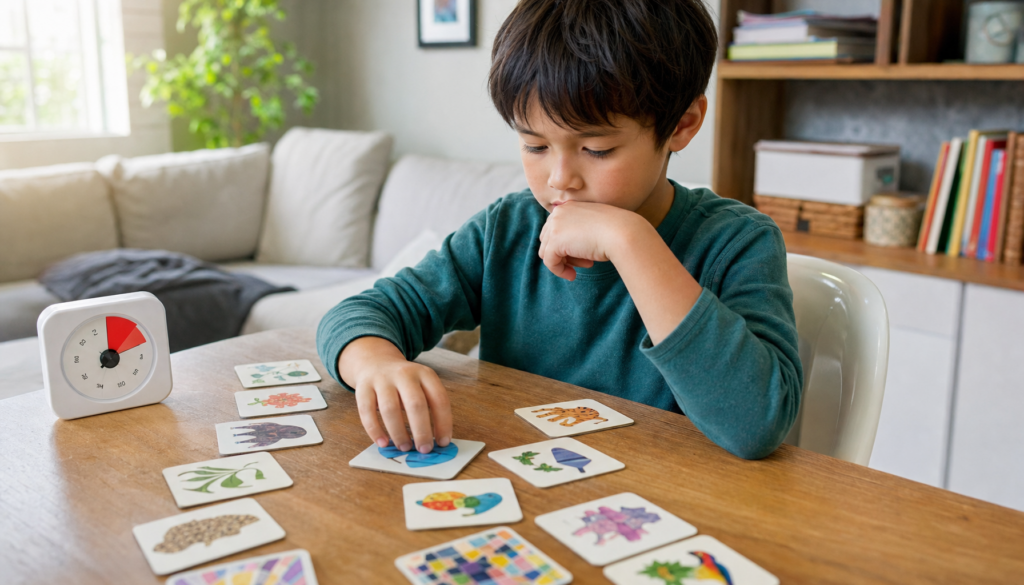
Building concentration skills for kids can sometimes feel challenging, especially when a child stares at a blank page, wanders away from homework, or loses track of instructions halfway through a task.ions halfway through a task, you know how frustrating concentration challenges can be.
But difficulty focusing does not necessarily mean a child is lazy, unmotivated, or unwilling to learn.
Concentration is a skill that develops over time.
Like reading, writing, organization, or time management, children can strengthen their ability to focus through practice, supportive routines, and activities that gradually challenge their attention.
Some children develop these abilities more quickly than others. What matters is helping each child build from where they are now.
Why Children Sometimes Have Trouble Focusing
Before trying to improve concentration, it helps to consider what may be making focus difficult.
Several everyday factors can interfere with a child’s attention.
Too many distractions. Noise, screens, clutter, conversations, and activity nearby can compete for a child’s attention.
Physical needs. Hunger, fatigue, thirst, or simply needing to move can make sustained attention much harder.
Task difficulty. Work that feels too difficult can lead to frustration and avoidance. Work that feels too easy may not hold a child’s interest.
Unclear expectations. Children may struggle to begin when they do not understand exactly what they are supposed to accomplish.
Instead of treating distraction as misbehavior, parents can look for the reason behind it.
A few thoughtful adjustments can often make focusing considerably easier.
1. Create a Focus-Friendly Learning Space
Children do not need a perfect study room to concentrate. They need a space that helps reduce unnecessary distractions.
Start by clearing away materials that are not needed for the current activity. If your child is completing a math worksheet, for example, the table may only need the worksheet, a pencil, an eraser, and perhaps scratch paper.
Everything else can wait.
For families without a dedicated homework area, consider creating a portable “focus box.” Keep pencils, paper, basic supplies, and other frequently used materials in one container. Bring it out during learning time and put it away afterward.
This creates a simple routine that signals it is time to work.
Pay attention to noise as well. Some children work comfortably with quiet background sound, while others need as little noise as possible. Experiment with different locations until you find an environment that helps your child settle into the task.
Consistency also matters.
Using approximately the same location and routine each day reduces the number of decisions a child has to make before getting started.
2. Use Short Work Periods and Brain Breaks
Expecting an elementary-age child to sit and concentrate for a long, uninterrupted period can easily backfire.
Instead, divide work into manageable intervals.
A younger child might begin with 10 minutes of focused work followed by a short break. An older child may be comfortable working for 15 or 20 minutes before taking a break.
During the break, encourage movement.
Your child might stretch, walk around the room, get some water, or do a few jumping jacks. Then return to the next short work period.
The purpose is not to see how long a child can remain seated. The goal is to help them experience successful periods of focused attention.
As those successful periods accumulate, concentration can gradually become easier.
3. Build Attention Gradually
Concentration skills for kids can be strengthened much like physical stamina: gradually.
If your child currently struggles to remain focused for five minutes, expecting 30 minutes tomorrow will probably create frustration.
Start with what is achievable.
Choose a task your child can work on for several minutes and use a simple visual timer. Explain that the goal is to work until the timer rings.
Once that becomes comfortable, add another minute or two.
Small increases can produce meaningful progress over several weeks without making practice feel overwhelming.
You can also reduce predictable interruptions before the timer begins. Encourage your child to use the bathroom, get a drink, gather necessary materials, and have a snack if needed.
Then begin.
When attention wanders, a calm reminder or pointing to the timer may be enough to redirect attention without turning the situation into a conflict.
4. Turn Concentration Practice Into Play
Not every concentration-building activity needs to look like schoolwork.
Games can provide excellent practice because children are naturally motivated to pay attention when they are having fun.
Simon Says encourages careful listening, working memory, and impulse control. Increase the challenge gradually by adding two-step or three-step directions.
Memory matching games encourage children to remember locations and retrieve visual information.
I Spy helps children scan an environment, ignore irrelevant information, and locate a specific target.
Pattern activities using blocks, beads, shapes, or household objects challenge children to observe and reproduce increasingly complex sequences.
Puzzles encourage sustained attention, visual reasoning, and persistence.
These activities can take only five or ten minutes.
They can also be especially useful before homework because they provide a playful transition into more structured learning.
5. Help Children Notice Their Own Progress
Children are more likely to continue practicing a skill when they can see themselves improving.
Instead of focusing only on completed assignments or correct answers, notice improvements in the process.
You might say:
“You stayed with that problem even when it became difficult.”
“You remembered all three directions.”
“You finished your focus time before taking your break.”
“You caught yourself getting distracted and came back to the activity.”
These observations help children recognize that concentration is something they are learning to control.
A simple weekly reflection can help too.
Ask your child:
What helped you focus this week?
What distracted you?
What could we try differently next time?
Over time, children can begin identifying the strategies that work best for them.
6. Connect Better Focus With Greater Independence
Improved concentration affects much more than homework.
Children who become better at directing their attention may find it easier to listen to instructions, complete multi-step tasks, organize their work, solve problems, and persist when something becomes challenging.
These abilities also support independence.
When children can remain with a task and recognize when their attention has wandered, they need fewer reminders from adults.
That does not happen overnight.
Independence develops through many small successes: completing a worksheet, following several directions, finishing a household responsibility, working through a puzzle, or returning to a task after becoming distracted.
Each experience reinforces an important message:
I can stay with something and finish it.
Practice Builds Stronger Concentration Skills
There is no single trick that suddenly gives a child perfect concentration.
The more effective approach is consistent, manageable practice.
Create an environment that supports attention. Keep work periods realistic. Provide opportunities for movement. Reduce unnecessary distractions. Use games to make practice enjoyable. Gradually increase the challenge as your child’s abilities grow.
Most importantly, recognize progress.
Five focused minutes can become ten. Ten can become fifteen. A child who once needed constant reminders may eventually begin managing tasks independently.
Those small improvements add up.
For families who want additional structured practice, the Encouraging Learning Concentration Skills Workbook for Kids provides engaging activities designed to help children practice attention, memory, problem solving, sequencing, and related thinking skills.
Because stronger concentration is not just about getting today’s homework finished.
It is about helping children develop learning skills they can continue using as they grow.