
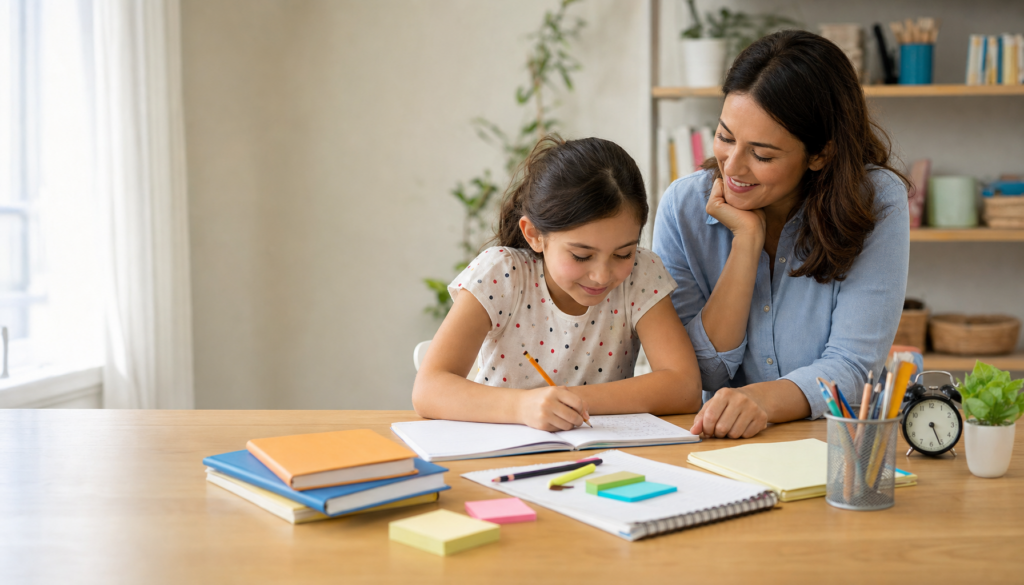
You may have watched your child stare at an open textbook, highlight half the page, and close the book feeling as though very little actually stuck.
That can be frustrating for both children and parents.
But most children do not automatically know how to study effectively. Studying is a skill, and like reading, writing, organizing a backpack, or learning to ride a bike, it develops through instruction and practice.
Strong study habits for kids are built gradually. Children learn how to organize their work, manage their time, focus their attention, remember information, and prepare for assignments through repeated experience.
Parents can play an important role in that process without becoming the homework police. The goal is not to manage every assignment for your child. It is to provide enough structure and guidance for children to gradually learn how to manage their own learning.
Here are several practical ways to begin.
Build a Homework Routine That Actually Sticks
A good time to establish a homework routine is before a major test or project creates pressure.
A consistent routine reduces the number of decisions a child has to make. Instead of wondering when or where homework will happen, those expectations become familiar.
Start with a reasonably consistent time.
For one family, homework might begin after an afternoon snack. For another, it might happen before dinner or after an extracurricular activity. The exact time matters less than establishing a predictable pattern on most school days.
Next, designate a regular place for schoolwork.
It does not need to be an elaborate study area. A corner of the kitchen table with pencils, paper, and other basic supplies can work perfectly well.
What matters is creating an environment where children can concentrate without unnecessary distractions.
Phones, television, games, and other attention-grabbing devices can make sustained concentration much more difficult. When possible, reduce these distractions during focused study periods.
A simple visual checklist can also help.
For example:
- Complete math worksheet
- Read for 15 minutes
- Review spelling words
- Pack backpack for tomorrow
Crossing off completed tasks helps children see their progress and makes an evening’s workload feel more manageable.
Consistency is usually more valuable than occasional marathon study sessions. Twenty focused minutes practiced regularly can help establish better habits than waiting until the night before a test for a long cram session.
The repetition of showing up and completing the routine is part of developing lasting study skills.
Break Big Assignments Into Smaller Steps
Large assignments can feel overwhelming to children because they often see the final result without understanding the steps required to get there.
Imagine a science project that is due several weeks from now.
A child may look at the assignment and think, “I don’t even know where to start.”
Instead of solving the problem for them, help them turn the assignment into smaller tasks.
A science project might become:
- Choose a topic.
- Gather several reliable sources.
- Develop the question or hypothesis.
- Complete the experiment or model.
- Record the results.
- Prepare the presentation.
- Practice presenting it.
Suddenly, one intimidating project becomes seven manageable activities.
The same strategy can work for book reports, research assignments, presentations, studying for tests, or almost any multi-step school project.
Writing these steps on a calendar, planner, whiteboard, or checklist makes the process even clearer.
Each completed step becomes visible progress.
Breaking assignments into smaller pieces also teaches children an important time-management lesson. They begin learning that large projects do not have to be completed all at once.
This can reduce last-minute cramming while helping children develop confidence in their ability to handle increasingly complex assignments.
Make Focus, Note-Taking, and Active Learning Simple
Establishing a routine is only the beginning. Children also need strategies for using their study time effectively.
Three particularly useful areas are concentration, note-taking, and active learning.
Build Focus in Manageable Blocks
Long study sessions can be difficult, especially for younger learners.
Instead, try shorter periods of focused work followed by brief breaks. Depending on the child’s age and attention span, this might mean 15 or 20 minutes of focused work followed by a five-minute break.
The appropriate amount of time will vary from child to child.
The objective is not to see how long a child can sit at a desk. The objective is to help them experience what focused work feels like and gradually strengthen that ability.
Teach Simple Note-Taking
Note-taking can also develop gradually.
Younger children might begin by writing a few important words, drawing pictures, or using sticky notes to identify important information.
Older students can experiment with more structured approaches, such as dividing notes into main ideas, supporting details, keywords, and questions.
The important lesson is that taking notes should require children to think about what they are learning rather than simply copy everything they see.
Encourage Active Recall
Simply rereading material can feel productive because the information looks familiar. However, children also benefit from practicing retrieving information without looking at the answer.
After reading a section, ask your child to close the book and explain what they remember.
Other options include:
- Creating flashcards
- Making a short practice quiz
- Explaining the lesson to someone else
- Writing several facts from memory
- Turning vocabulary review into a game
- Drawing a diagram of what they learned
These activities make the learner do something with the information.
That is an important shift from simply looking at material to actively working with it.
Help Your Child Become an Independent Learner
Parents often begin by doing much of the organizing.
You may check the backpack, remind your child about tomorrow’s test, locate the missing worksheet, and make sure every assignment gets finished.
Some support is appropriate, particularly when children are first developing these skills.
But the long-term goal is gradually transferring responsibility to the child.
One place to start is goal setting.
Ask your child to choose a manageable goal for the week, such as:
- Finish the reading log by Thursday.
- Review vocabulary words twice before Friday’s quiz.
- Pack the school bag before bedtime.
- Complete homework before screen time.
- Remember to bring home the materials needed for an upcoming project.
Children can also begin using a simple planner or weekly schedule.
Encourage them to write their own assignments rather than having you do it for them. Their system may not be perfect at first, and that is part of learning.
Self-checking is another useful habit.
Before reviewing an assignment yourself, ask your child to look over the work first.
Can they find a mistake? Did they answer every question? Did they follow the directions? Is their name on the page?
These simple questions encourage children to become responsible for checking their own work.
Independence develops gradually. A forgotten assignment or messy planner does not mean the process has failed.
Organization, focus, planning, time management, and self-checking reinforce one another. As children become stronger in one area, managing the others often becomes easier.
Strengthen Study Skills Through Practice
Good study habits for kids do not develop overnight.
Progress often appears through small changes.
Perhaps your child begins setting up their study space without being reminded. Maybe they remember an upcoming assignment on their own. Perhaps they notice a mistake before turning in their homework.
These moments matter because they show that responsibility is gradually shifting from parent to child.
A brief weekly check-in can help children recognize their own progress.
Consider asking:
What worked well this week?
What was difficult?
What could we try differently next week?
The conversation does not need to become another evaluation. The purpose is to encourage children to think about how they learn.
After a larger test, paper, or project, you can use the same approach.
What helped?
What did not?
Did starting earlier make a difference?
Was the study method effective?
What would they change next time?
This kind of reflection helps children understand that learning is a process they can improve.
Good Study Habits Build More Than Better Grades
Developing study skills is not simply about completing tonight’s homework.
Children are also practicing planning, organization, concentration, problem solving, goal setting, time management, and personal responsibility.
Those skills become increasingly important as schoolwork becomes more demanding and children are expected to work more independently.
Parents do not have to teach every skill at once.
Choose one area that would make the biggest difference for your child right now. Establish a manageable routine, practice it consistently, and build from there.
Small improvements practiced repeatedly can become strong habits.
And each time children discover that they can plan their work, solve a problem, remember an assignment, or prepare successfully for a test, they gain something just as valuable as another completed homework page: greater confidence in their ability to learn.
Continue Building Strong Study Skills
If your child would benefit from more structured practice, the Encouraging Learning Study Skills Workbook for Kids provides guided activities designed to help children strengthen practical learning habits, including organization, focus, planning, note-taking, goal setting, and independent study skills.
It can be used at home as a practical next step for reinforcing many of the skills introduced in this article.