
Every parent knows the moment.
Your child is stuck on something, looks at you with frustrated eyes, and your first instinct is to fix it.
You provide the answer, solve the puzzle, explain the homework problem, or settle the disagreement before it gets worse.
Sometimes children need our help. But when adults provide the solution every time a problem appears, children miss opportunities to practice finding solutions themselves.
Problem solving skills for kids are developed through practice.
Children need opportunities to encounter manageable challenges, think about what they could do, make choices, and discover what happens next.
Fortunately, parents do not need elaborate lessons to make this happen. Everyday life provides plenty of opportunities.
A lost shoe. A difficult homework assignment. A disagreement with a sibling. A plan that unexpectedly changes. A puzzle that does not seem to have an obvious answer.
Each can become an opportunity to practice critical thinking, decision making, persistence, and independence.
A Simple 6-Step Problem Solving Process for Kids
Children benefit from having a process they can use when something goes wrong.
The following six steps provide a simple framework that can be practiced again and again.
1. Identify the Problem
Children sometimes react to the emotion surrounding a problem before they can clearly explain what happened.
Help your child identify the actual issue.
Instead of “My brother is mean,” the specific problem might be, “My brother took the game I was using without asking.”
Ask:
“What is the problem we are trying to solve?”
Putting the problem into words makes it easier to think about possible solutions.
2. Think of Possible Solutions
Resist the temptation to immediately offer your solution.
Instead, ask:
“What do you think you could try?”
Encourage your child to think of several possibilities.
Not every idea needs to be practical. Brainstorming helps children discover that problems often have more than one possible solution.
3. Consider What Might Happen
Once your child has several possibilities, talk about each one.
Ask:
“What might happen if you choose that?”
This helps children connect choices with consequences.
They begin thinking beyond what they want to do right now and considering what could happen afterward.
4. Choose an Option
When appropriate, allow your child to choose which reasonable solution to try.
Making the choice matters.
Children develop confidence when they experience themselves making decisions rather than always following decisions made for them.
5. Try the Solution
Now comes the important part: actually trying it.
The solution may work beautifully. It may work only partially. It may not work at all.
All three outcomes provide useful experience.
6. Reflect on What Happened
Afterward, talk briefly about the result.
Ask:
“How did that work?”
“What would you do differently next time?”
Reflection helps children connect their decisions with outcomes and prepares them to handle similar situations more effectively in the future.
Practice Problem Solving Skills for Kids in Everyday Life
The six-step process becomes more meaningful when children use it with real situations.
Consider a few common examples.
When Siblings Disagree
Two children want the same toy or game.
Instead of immediately deciding who gets it, ask them to describe the problem.
Then ask:
“What could you do so both of you have a fair solution?”
They might suggest taking turns, using a timer, trading for something else, or playing together.
Help them consider the possibilities and choose a reasonable solution.
The objective is not merely ending the disagreement. It is giving children experience resolving one.
When Homework Feels Overwhelming
Your child sits in front of an assignment and says, “I can’t do this.”
Rather than immediately explaining everything, ask:
“Which part feels difficult?”
Once the problem becomes specific, ask:
“What could you try first?”
Perhaps the assignment can be divided into smaller pieces. Maybe your child needs to reread the directions, look at an example, make an outline, or begin with the easiest part.
Finding the first step is itself a problem-solving skill.
When Plans Change
Suppose a playdate is canceled or bad weather ruins an anticipated outdoor activity.
You cannot eliminate the disappointment, but you can help your child decide what happens next.
Ask:
“What else could we do?”
A child who learns to generate alternatives is practicing flexibility, one of the most useful components of problem solving.
Ask Questions Instead of Always Providing Answers
One of the simplest ways parents can strengthen problem solving skills for kids is by changing the questions they ask.
When a child immediately receives an answer, the thinking has already been done for them.
A thoughtful question hands some of that thinking back.
Try questions such as:
When your child is stuck:
“What do you think you could try?”
When frustration takes over:
“What part feels hardest right now?”
When your child chooses quickly:
“What might happen if you do that?”
When your child wants to quit:
“What have you already tried?”
When several choices are possible:
“Which choice do you think would work best, and why?”
These questions encourage children to stop, think, and explain their reasoning.
Parents do not need to turn every situation into a lesson. Sometimes a child simply needs an answer or immediate assistance.
But when circumstances allow, asking rather than immediately solving creates valuable opportunities for independent thinking.
Use Mistakes as Information
Problem solving would be much easier if every first attempt worked.
Of course, it does not.
A science experiment fails. A tower collapses. A child chooses an ineffective solution to a disagreement. A school project takes longer than expected.
These experiences can be frustrating, but they also provide some of the best opportunities for learning.
When something does not work, help your child examine what happened without treating the result as a failure.
Ask:
“What part worked?”
“What didn’t work?”
“What could you change?”
“What would you try next?”
The goal is to help children understand that an unsuccessful attempt provides information.
Perhaps the original idea needs a small adjustment. Perhaps they need an entirely different approach.
Either way, the process of trying, evaluating, and trying again builds persistence.
Children gradually learn that encountering difficulty does not mean they are incapable of solving the problem.
It means they have more thinking to do.
Make Problem Solving Fun
Problem solving does not have to begin with actual problems.
Games and activities provide excellent practice.
Puzzles encourage children to look for patterns and test possibilities.
Building activities with blocks or construction toys require planning and adjustment.
Mazes encourage children to anticipate where a path might lead.
Strategy games require choices and consequences.
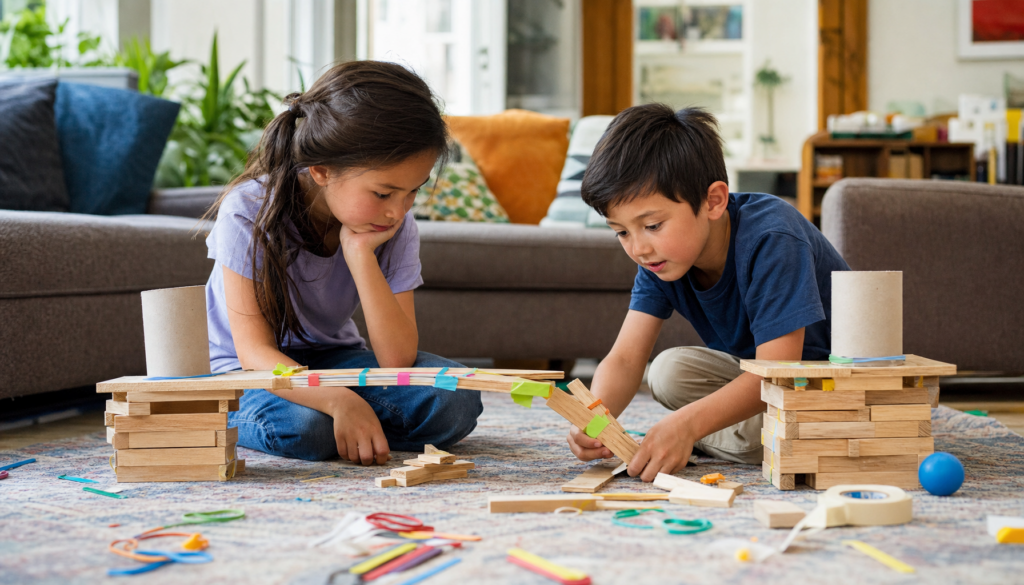
Creative challenges can be especially effective. Give your child a collection of household materials and challenge them to build the tallest tower, create a bridge for a toy car, or design a container that can protect an object from a short fall.
There may be many possible solutions.
That is exactly the point.
Children learn that thinking is something they can experiment with rather than something that always produces one immediate correct answer.
Give Children Room to Become More Independent
As children strengthen their problem-solving abilities, parents can gradually provide less direction.
A younger child may need you to walk through every step:
“What is the problem?”
“What could you try?”
“What do you think will happen?”
An older or more experienced child may eventually need only one prompt:
“How could you solve this?”
That progression matters.
The objective is not for parents to disappear from the process. It is for children to increasingly take ownership of it.
Eventually, a child begins asking the questions internally.
What is the problem?
What are my options?
What might happen?
What should I try?
Did it work?
What can I do differently?
That is when a strategy begins becoming a habit.
Problem Solving Grows Through Practice
Children will not use this process perfectly every time.
They may become frustrated. They may choose an option that does not work. They may still ask you to solve something they could probably handle themselves.
That is part of learning.
Problem solving skills for kids grow through repeated opportunities to think, choose, try, and reflect.
Every time you resist immediately providing an answer and instead ask, “What do you think you could try?” you create one more opportunity for independent thinking.
Over time, those small moments can strengthen critical thinking, decision making, persistence, and confidence.
For families who want additional structured practice, the Encouraging Learning Problem-Solving Workbook for Kids provides activities designed to help children practice reasoning, decision making, cause and effect, planning, and other problem-solving skills.
Everyday challenges will continue to appear.
The valuable lesson for children is discovering that they have tools they can use when they do.