
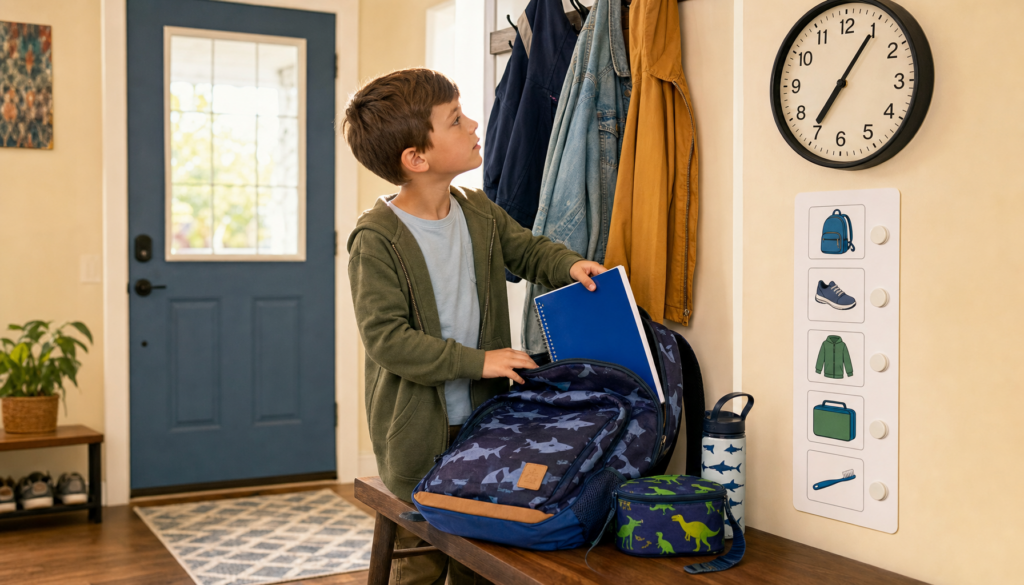
If you’ve ever watched your child stare blankly at a messy room twenty minutes before it is time to leave, you know the feeling. You wonder why they can’t simply see that the clock is ticking.
For many children, however, “five more minutes” can still feel surprisingly abstract. They are often much more focused on what they are doing right now than on what needs to happen fifteen or thirty minutes from now.
This isn’t a character flaw. Time awareness develops through experience, practice, and guidance.
Expecting a seven-year-old to instinctively manage a schedule is a little like expecting a child to ride a bike without first learning how. These abilities need to be developed.
Instead of viewing organization as something a child either has or doesn’t have, it is more helpful to treat time management skills for kids as learned abilities. Children can become better at understanding time, planning ahead, estimating how long things take, and completing routines with less adult supervision.
The goal isn’t perfection. It’s progress.
And one of the best places to begin is by making time more visible and understandable.
Building the Foundation With Visual Schedules and Daily Routines
Picture a school morning where your child knows what comes next without you having to repeat every instruction. That’s the potential of a good visual schedule.
Visual schedules turn an invisible sequence of responsibilities into something children can actually see.
Instead of repeatedly saying “hurry up,” your child can see the progression: get dressed, eat breakfast, brush teeth, put on shoes, grab backpack.
Start with the busiest parts of the day, such as morning, after-school, and bedtime routines.
For each one, list the steps in order. Keep the sequence manageable. Five to seven steps may be plenty for many elementary-age children.
Photos can work especially well for younger children, but simple drawings, icons, or written checklists can accomplish the same thing.
The key is making the schedule easy to see and use.
Put it on the refrigerator, bathroom mirror, bedroom wall, or another place your child naturally encounters during the routine. A dry-erase checklist can allow children to mark each step as they complete it.
You can also pair the schedule with a visual timer. Seeing time gradually disappear can make a five- or ten-minute period easier to understand than simply hearing an adult announce how much time remains.
The same idea works after school. A predictable sequence might include snack, homework, chores, free time, dinner, and preparation for tomorrow.
Over time, something important begins to happen.
Instead of asking your child, “Why aren’t you ready yet?” you can ask a much simpler question:
“What’s next?”
The routine gradually begins replacing some of the reminders.
Once children become comfortable following a sequence, you can start teaching another important skill: estimating how much time things actually take.
Teaching Kids to Estimate Time and Plan Backward
Ask your child how long they think it takes to clean up their toys, get dressed, finish a page of math problems, pack a backpack, or prepare for bed.
Write down the estimate.
Then time the activity.
The objective isn’t to prove that their estimate was wrong. You’re helping them develop a more realistic understanding of duration.
You can even make it a game.
“Do you think putting on your pajamas will take two minutes or ten?”
“How long do you think it takes us to get from the house to soccer practice?”
“Can you finish putting your books away before the five-minute timer ends?”
With repetition, children can begin developing a better sense of how long familiar activities take.
This is one of the most useful time management skills for kids because planning becomes much easier once children understand that activities require actual blocks of time.
Next, introduce planning backward.
Suppose your family needs to leave the house at 9:00 AM.
Ask your child what needs to happen before then.
If the drive takes 30 minutes, you need to leave at 8:30. If getting dressed, eating breakfast, brushing teeth, and gathering everything takes about 45 minutes, those activities need to begin well before 8:30.
Work backward together.
The same strategy can be used with school assignments. If a project is due Friday, what should be finished Thursday? What could be done Wednesday? What needs to begin Monday or Tuesday?
Planning backward helps children see that deadlines aren’t isolated events. They are connected to decisions and actions that happen beforehand.
Using Clocks, Timers, and Priorities to Build Independence
Once your child begins understanding how long activities take, clocks and timers can become useful planning tools.
The important distinction is how you use them.
A timer shouldn’t become another source of pressure. Instead, it can provide a clear boundary around an activity.
For example:
“Let’s see how much you can clean up in five minutes.”
“Work on this for fifteen minutes, and then we’ll take a break.”
“We need to leave at 8:10. Check the clock and tell me when we have ten minutes left.”
These small exercises shift some responsibility from the parent to the child.
Older elementary-age children can begin using clocks, simple planners, and written schedules more independently.
Prioritization is another important skill.
A long list can feel overwhelming, so teach children to separate responsibilities into manageable groups.
After school, for example, the afternoon might consist of:
- Snack and unwind
- Homework
- Chores
- Free time
Within the homework period, ask questions rather than immediately giving instructions.
“Which assignment is due first?”
“Which one do you think will take the longest?”
“What should you start with?”
These questions encourage children to think through the decision themselves.
A simple “must do, then can do” structure can also help younger children understand priorities. Responsibilities come first, followed by optional activities.
Over time, these strategies help turn time management skills for kids into habits children can increasingly manage for themselves.
Reviewing and Adjusting: Turning Mistakes Into Learning Moments
Plans don’t always work.
That’s actually part of learning how to plan.
A forgotten library book, rushed homework assignment, or missed deadline can provide a useful opportunity to figure out what went wrong and what could work better next time.
Try a short review at the end of the day.
Ask:
“What worked well today?”
“What was difficult?”
“What could we do differently tomorrow?”
Keep the conversation curious rather than critical.
If your child forgot a library book, instead of saying, “You didn’t follow the schedule,” try asking:
“What could we add to the morning checklist so it’s easier to remember your library book next time?”
When children participate in developing the solution, they also practice thinking ahead.
A weekly review can help identify larger patterns.
Maybe homework works better before soccer practice. Perhaps backpacks should be packed the night before. Maybe the morning schedule needs one fewer activity.
Plans should be useful tools, not rigid rules.
Teaching children to review and adjust their plans helps them understand that a mistake doesn’t mean they are “bad at time management.” It simply provides information they can use the next time.
Gradual Responsibility: From Parent-Led to Child-Led Time Management
Everything we’ve discussed leads toward one larger goal: helping children manage more of their own responsibilities.
That transition should happen gradually.
At first, you may create the schedules, set the timers, and provide most of the reminders.
As your child becomes more capable, begin stepping back.
Instead of telling them what comes next, point toward the schedule.
Instead of announcing that it is time to leave, ask them to check the clock.
Instead of organizing tomorrow’s school materials yourself, ask:
“What do you need to have ready for tomorrow?”
There will still be forgotten items, misjudged time, and mornings when everything takes longer than expected. Those experiences are part of developing the skill.
With consistent practice, however, you may begin noticing small changes.
Your child checks the clock without being asked.
They start homework because they know what comes next.
They pack something the night before.
They realize that a large project needs to be started earlier.
Those moments matter.
Strong time management skills for kids aren’t built through one perfect schedule. They’re developed through repeated opportunities to plan, practice, make mistakes, adjust, and try again.
Some children will develop these habits faster than others. What matters is creating opportunities for them to practice at a level appropriate for their age and abilities.
Structured activities can also provide additional practice with telling time, estimating duration, planning routines, prioritizing tasks, and setting goals.
The ultimate goal isn’t simply getting children out the door on time.
It’s helping them gradually develop the confidence to plan their responsibilities, adapt when plans change, and take greater ownership of their own time.