
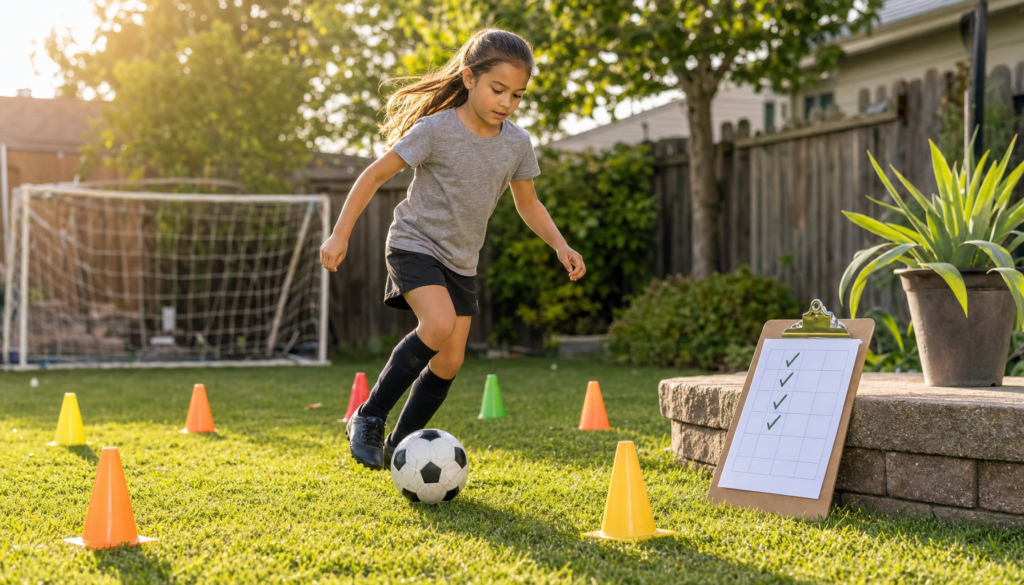
Your child may want to read more books, get better at soccer, improve in math, or save enough money to buy something special.
That’s a wonderful starting point, but it isn’t quite a goal yet.
The gap between wanting something and figuring out how to work toward it is where children often need some guidance.
Goal setting for kids is a practical life skill. It teaches children how to take a general desire and turn it into something they can actually work toward, one manageable step at a time.
When children practice this process, they begin learning skills that extend far beyond the individual goal. They practice planning, decision making, persistence, reflection, and taking greater responsibility for something that matters to them.
The important distinction is that a meaningful goal isn’t simply another assignment handed down by an adult.
You’re not giving your child another item for a to-do list. You’re helping them learn how to create the list themselves.
The objective isn’t to develop a perfect plan on the first try. It’s to show children that they can identify something they want to accomplish, decide what actions could move them toward it, and adjust their approach along the way.
So when your child says they want to improve at something, resist the temptation to immediately hand them a plan.
Get curious instead.
Ask what that wish would look like if it came true.
That conversation can be the first step toward turning a hope into an achievable goal.
Goal Setting for Kids Starts With a Goal That Matters to Them
Your child may already know what they want.
Maybe it’s “I want to get better at math.”
Perhaps it’s “I want to learn to draw dinosaurs,” “I want to read more books,” or “I want to make the soccer team.”
That desire is the beginning of a goal, but it needs enough structure for a child to act on it.
Start by helping your child choose one goal that genuinely matters to them.
This doesn’t mean parents can’t provide guidance. Some goals naturally involve responsibilities children need to develop. But whenever possible, give your child some ownership over what they are trying to accomplish and how they will approach it.
Try questions such as:
“What’s something you’d really like to be able to do?”
“What would make you feel proud?”
“Is there something you’d like to get better at this month?”
“What would you like to be able to do by yourself?”
Then help make the answer more specific.
“Get better at math” is difficult to act on.
“Practice my multiplication facts for ten minutes three days each week” gives the child something concrete to do.
“Read more” can become “Read one chapter before bed on Monday, Wednesday, and Friday.”
Ask your child:
“How will you know when you’ve accomplished your goal?”
That question helps turn a wish into something more concrete.
For children who are just beginning, keep the number of goals manageable. One meaningful goal provides an opportunity to learn the process without becoming overwhelmed.
Once the goal is clear, it’s time to break it into smaller steps.
Breaking a Goal Into Small, Achievable Steps
A goal can feel exciting when a child chooses it.
Then comes the work.
That’s where a big goal can suddenly feel overwhelming.
The solution is to make the next action small enough to understand and manageable enough to begin.
Sit with your child and ask:
“What’s one small thing you could do first?”
Suppose the goal is to become a stronger reader.
Instead of simply writing “read more,” the first step might be reading for fifteen minutes after dinner three evenings each week.
If the goal is keeping a bedroom organized, the first step might be putting clothes away before bedtime.
If the goal is saving for a toy, the first step might be deciding how much money to save each week.
Here are a few examples:
School: “Improve my spelling” might become “Practice five spelling words each evening.”
Reading: “Read more books” might become “Read one chapter three nights each week.”
Hobbies: “Learn to draw” might become “Complete one drawing exercise every Sunday.”
Sports: “Improve at soccer” might become “Practice ball control for ten minutes after school twice each week.”
Household responsibilities: “Help more at home” might become “Empty the dishwasher every Monday and Thursday.”
Organization: “Keep my desk cleaner” might become “Spend five minutes putting away papers and supplies after homework.”
Saving money: “Save for a new toy” might become “Put one dollar into my savings jar each week.”
The exact goal matters less than learning the process.
Small steps give children opportunities to experience progress. Instead of staring at a distant finish line, they can concentrate on the next action.
A simple timeline can help as well.
For a weekly goal, choose specific days for the action. For a longer goal, mark a few checkpoints on a calendar.
The objective isn’t to create a complicated project-management system. It’s to help children see the connection between what they want and what they need to do next.
Tracking Progress and Celebrating Milestones
Progress can be difficult for children to recognize when it happens gradually.
That’s why visual tracking can be especially useful.
A sticker chart, checklist, calendar, reading log, savings tracker, or progress bar can turn effort into something children can see.
For a reading goal, your child might add a sticker every time they complete a chapter.
For a savings goal, they might color part of a picture each time they add money to their savings.
For a practice goal, they could put a checkmark on the calendar after each session.
Keep the system simple enough that your child can participate in maintaining it.
That reinforces ownership.
Milestones also deserve recognition, but they don’t necessarily require prizes.
Sometimes the most useful celebration is simply noticing what happened.
“You practiced three times this week, just like you planned.”
“You’ve already saved half of what you need.”
“You finished two books this month.”
Specific recognition helps children connect their actions with their progress.
Keep the emphasis on effort, consistency, improvement, and learning rather than comparison.
Goal setting for kids works best as a personal process. Your child’s progress doesn’t need to look like a sibling’s, friend’s, or classmate’s progress.
When children can see that their actions are moving them forward, they have another reason to keep going.
When the Plan Doesn’t Work
Sooner or later, every goal encounters a problem.
Your child may miss several days of practice. They may discover that a step is harder than expected. Their schedule may change. They may even lose some enthusiasm for the original goal.
That doesn’t automatically mean the goal has failed.
It means there is something to learn.
Instead of immediately fixing the problem for your child, ask:
“What got in the way?”
“What part was harder than you expected?”
“Do we need to change the plan?”
“What’s something different you could try?”
Sometimes the solution is simple.
Perhaps practicing before dinner works better than practicing afterward.
Maybe a twenty-minute activity needs to become ten minutes.
Perhaps the goal was too ambitious and needs another intermediate step.
Adjusting a plan isn’t the same as quitting.
In fact, learning when and how to adjust is an important part of goal setting.
When children experience a setback, focus your encouragement on what they can control.
“I noticed that you tried again.”
“You figured out another way to approach it.”
“You didn’t reach the goal this week, but now you know what made it difficult.”
These conversations teach children that progress isn’t always a straight line.
The ability to reflect, adjust, and continue is one of the most valuable lessons goal setting for kids can provide.
Making Goal Setting a Regular Habit
Goal setting becomes more useful when children have opportunities to practice it repeatedly.
A simple journal, goal tracker, planning page, or notebook can provide a place to record goals and reflect on progress.
It doesn’t need to be complicated.
At the beginning of the week, your child might write:
My Goal
Why It Matters to Me
Three Steps I Can Take
How I’ll Track My Progress
At the end of the week, add:
What Went Well?
What Was Difficult?
What Will I Try Next?
Younger children can draw their answers instead of writing them.
These short reflections help children think about the process rather than focusing only on whether they reached the final goal.
You can also vary the kinds of goals children practice.
One month might involve reading. Another could involve saving money, learning a new skill, improving a routine, completing household responsibilities, or practicing something they enjoy.
Structured goal-setting activities and journals can provide additional practice with choosing goals, creating action steps, tracking progress, and reflecting on results.
Over time, children may begin using the process with less help.
They identify something they want to accomplish.
They think about the steps.
They make a plan.
They notice when the plan isn’t working.
They adjust.
And eventually, they recognize something important:
They can make progress because of choices and actions they took themselves.
That’s the real value of goal setting for kids.
It isn’t producing a perfect plan or reaching every goal on the first attempt.
It’s helping children discover that they can turn an idea into action, learn from what happens, and take increasing responsibility for where they want to go next.