
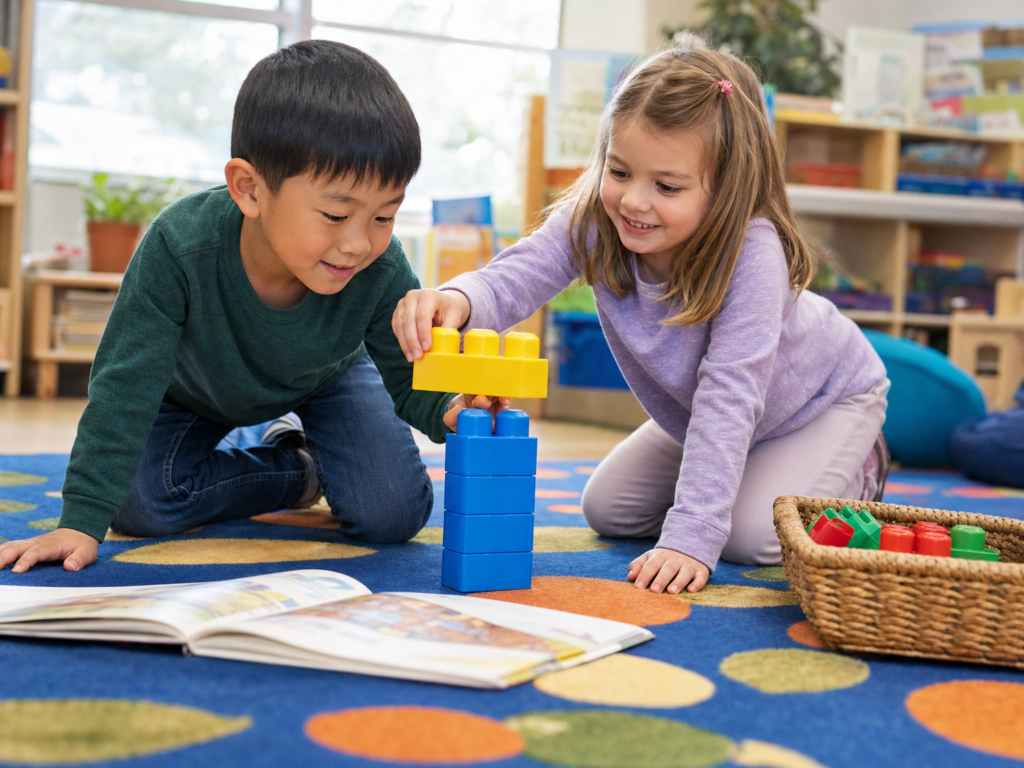
Addition is one of the first major steps children take from counting numbers to actually using them.
A child may be able to count confidently to 20 and still wonder what to do when asked, “What is 6 plus 3?” That is because addition for kids involves more than remembering answers. Children are learning an entirely new idea: two quantities can be combined to create a larger quantity.
For some learners, that idea seems to click quickly. Others need to see it, touch it, draw it, talk through it, and practice it in several different ways.
That is perfectly reasonable. Early addition is not just about getting answers. It is about developing relationships between numbers.
The strongest approach is usually not to teach one method and insist that every problem be solved the same way. Instead, children can develop a small collection of strategies they understand and learn when each one is useful.
Here are eight practical ways parents and teachers can help young learners build a stronger understanding of addition.
1. Start Addition for Kids With Real Objects
Before addition appears as symbols on a worksheet, children can experience it physically.
Place four blocks on a table.
Then place three more nearby.
Ask:
“How many blocks are in this group?”
“How many are in this group?”
Then push the two groups together.
“How many are there altogether?”
The child can count the combined group and discover that four and three make seven.
That simple activity contains the central idea behind addition: combining quantities to make a new total.
You can use almost anything:
- Building blocks
- Buttons
- Toy animals
- Craft sticks
- Crayons
- Plastic counters
- Toy cars
- Small balls
- Safe household objects
Start with small quantities that are easy to count.
If your child is working on 3 + 2, let the learner physically create a group of three and a group of two. Then combine them.
Once that feels comfortable, try slightly larger numbers.
Hands-on practice gives meaning to the symbols children will eventually encounter on paper.
When they later see:
3 + 2 = 5
the equation is no longer just a collection of marks.
It represents something they have actually done.
2. Use Number Bonds to Explore Parts and Wholes
One of the most useful ideas in early mathematics is that a number can be made in different ways.
Take the number 8.
Eight can be:
4 and 4
5 and 3
6 and 2
7 and 1
Children who understand these relationships begin seeing numbers as flexible rather than fixed.
A simple number bond can help.
Write 8 as the whole. Then show 5 and 3 as its two parts.
Later, show 6 and 2.
Ask:
“What two parts could make eight?”
You can also explore number bonds with objects.
Give your child seven blocks and two small bowls.
Ask the child to divide the seven blocks between the bowls.
Perhaps there are four in one bowl and three in the other.
Count them.
Still seven.
Try again.
Five and two.
Still seven.
Six and one.
Still seven.
This is valuable because the child begins discovering that the total remains the same even when its parts change.
Those relationships eventually support addition, subtraction, mental math, place value, and more advanced mathematical reasoning.
3. Teach the Counting-On Strategy
Young children often begin addition by counting everything from one.
Suppose the problem is:
5 + 3
A child might hold up five fingers, then three more, and count all eight from the beginning.
That works, but there is a more efficient strategy.
Start with 5.
Then count forward three numbers:
“Six, seven, eight.”
This is called counting on.
At first, use a number line or physical objects.
Place five counters together.
Say:
“We already know there are five here, so we don’t have to count those again.”
Then add one counter at a time:
“Six.”
“Seven.”
“Eight.”
Eventually, the child can perform the same process mentally.
You can also help children discover that the order of the numbers does not change the total.
For example:
3 + 7
and
7 + 3
both equal 10.
If counting on, starting with 7 is easier because the child only needs to count three additional numbers.
Do not worry if children continue using fingers or manipulatives while learning this strategy. Those tools can support understanding while more efficient mental strategies develop.
4. Make Ten to Simplify Addition
Ten is enormously important in our number system.
Helping children recognize combinations that make ten can make many addition problems easier.
Begin by exploring pairs:
1 + 9
2 + 8
3 + 7
4 + 6
5 + 5
A ten-frame is particularly helpful because children can actually see how many spaces remain.
Suppose eight spaces are filled.
Ask:
“How many more do we need to make ten?”
The child can see two empty spaces.
So:
8 + 2 = 10
Once these combinations become familiar, children can use them to solve other problems.
Consider:
8 + 5
Instead of counting five steps from eight, the child can think:
Eight needs two to make ten.
Break five into two and three.
8 + 2 = 10
10 + 3 = 13
At first, this may require blocks, counters, or a ten-frame.
That is fine.
The objective is not speed. It is understanding why the strategy works.
As children become more familiar with combinations that make ten, they may begin recognizing these relationships without needing physical materials.
5. Learn Doubles and Near Doubles
Some addition facts are naturally memorable.
Doubles are a good example:
1 + 1 = 2
2 + 2 = 4
3 + 3 = 6
4 + 4 = 8
5 + 5 = 10
As children become familiar with doubles, those facts can help them solve nearby problems.
Suppose a child knows:
6 + 6 = 12
Now consider:
6 + 7
One of the sixes has increased by one.
So the answer is one more than 12:
That is a near-double strategy.
Similarly:
5 + 5 = 10
Therefore:
5 + 6 = 11.
Or:
8 + 8 = 16
Therefore:
8 + 9 = 17.
Children do not have to use near doubles for every problem. The purpose is to give them another option.
One learner may see 7 + 8 and immediately think:
7 + 7 + 1.
Another may prefer making ten.
Both can reach the same correct answer through sound reasoning.
That flexibility is valuable.
6. Draw Addition and Use Number Lines
Physical objects are excellent for introducing addition, but children eventually need ways to represent their thinking without manipulatives.
Drawing provides a natural bridge.
For:
4 + 3
a child could draw four circles.
Then three more circles.
Then count all seven.
The circles do not need to be beautiful. Simple dots, lines, tally marks, or quick sketches are enough.
The drawing is there to represent the mathematics.
Try a number line
A number line introduces another useful representation.
For:
4 + 3
start at 4.
Make three jumps forward.
The child lands on 7.
This helps children visualize addition as movement toward larger numbers.
Later, number lines can support subtraction, skip counting, measurement, fractions, negative numbers, and many other concepts.
For a first grader, however, keep it simple.
Start.
Jump.
Land.
Then ask the child to explain what happened.
7. Explore Addition and Subtraction With Fact Families
Addition does not exist in isolation.
It is closely connected to subtraction.
Suppose we use the numbers:
3, 5, and 8.
They can create a family of related facts:
3 + 5 = 8
5 + 3 = 8
8 − 3 = 5
8 − 5 = 3
Children who understand this relationship are doing more than memorizing four equations.
They are learning how numbers relate.
You can demonstrate fact families with objects.
Place eight counters on the table.
Separate them into groups of five and three.
Ask:
“How many altogether?”
Eight.
Then cover three.
“How many can you still see?”
Five.
The same three numbers can tell several related mathematical stories.
This is especially helpful as children transition from addition into subtraction because subtraction no longer feels like an entirely unrelated operation.
8. Practice Addition Through Games and Everyday Life
Worksheets can provide useful practice, but they should not be the only place children encounter addition.
Everyday situations give addition a purpose.
At snack time:
“You have three crackers. If I give you two more, how many will you have?”
While building:
“Your tower has five blocks. What happens if you add three more?”
While cleaning:
“There are four cars in the box and two on the floor. How many cars do we have altogether?”
At the grocery store:
“We have two apples. Let’s get three more. How many will we have?”
These are small questions, but they reinforce the meaning of addition.
Turn practice into a game
Games can also provide repeated practice without making every session feel like a lesson.
Try rolling two dice and finding the total.
Or use playing cards with the face cards removed. Turn over two cards and add their values.
You can also create a simple addition hunt.
Say:
“Find two groups of objects that make eight.”
Your child might bring three crayons and five blocks.
Then ask:
“Can you find another way to make eight?”
Now addition has become exploration.
Why Multiple Addition Strategies Matter
Adults sometimes wonder why children need several strategies when they could simply memorize the facts.
Fact fluency is useful.
But understanding should accompany it.
Imagine a child forgets that 8 + 7 = 15.
If the fact exists only as something memorized, the child may be stuck.
A child with several strategies has options.
The learner might think:
Make ten:
8 + 2 = 10, with 5 remaining, so 15.
Or:
Near doubles:
7 + 7 = 14, plus 1 = 15.
Or:
Count on:
Start at 8 and count seven more.
The child can reconstruct the answer instead of depending entirely on memory.
Over time, many frequently used facts will become automatic anyway.
The difference is that fluency grows on top of understanding.
Help Children Explain Their Thinking
One of the most useful questions you can ask during addition for kids practice is:
“How did you figure that out?”
Suppose your child answers 7 + 6 correctly.
Rather than immediately moving to the next problem, ask how the answer was found.
You might hear:
“I knew 6 + 6 was 12, so one more is 13.”
That tells you the child used a near-double strategy.
Another child might say:
“I gave three from the six to the seven to make ten, and then I had three left.”
That child made ten.
Another may say:
“I started at seven and counted six more.”
That child counted on.
The explanation gives you insight into what the learner understands.
It also encourages children to recognize their own strategies.
Math becomes less about guessing what answer an adult wants and more about reasoning.
Avoid Rushing From Understanding to Memorization
There is nothing wrong with eventually knowing basic addition facts quickly.
Fluency makes later mathematics easier because children do not have to devote as much attention to simple calculations while solving more complicated problems.
But speed should not replace understanding.
A child who is still learning what addition means benefits from combining objects, drawing pictures, using number lines, and talking through problems.
Flashcards can be introduced as one form of practice once the underlying relationships make sense.
They should not be the entire learning experience.
Think of fluency as the result of repeated meaningful encounters with numbers.
Understanding comes first.
Practice strengthens it.
Familiarity gradually makes many answers easier to recall.
Do Not Make Finger Counting the Enemy
Parents sometimes become concerned when a first grader continues using fingers.
Fingers are a readily available mathematical tool.
For a child who is learning addition, using them can provide a concrete way to keep track of quantities.
Instead of simply telling a child to stop using fingers, introduce other strategies alongside them.
Ask:
“Could we start at six and count on three?”
“Do you see a double that might help?”
“Could we make ten?”
Over time, children may naturally choose more efficient strategies because those strategies require less effort.
The objective is not to remove a tool before the child is ready.
It is to expand the child’s collection of tools.
Use Word Problems to Give Addition Meaning
A page filled with equations tells children how to calculate.
A word problem asks them to decide whether addition makes sense in a situation.
For example:
“Lena has four crayons. Her friend gives her three more. How many crayons does Lena have now?”
Before calculating, ask:
“What happened in the story?”
Did the quantity become larger or smaller?
Were two groups combined?
What are we trying to find?
Children can act out the story with crayons before writing an equation.
Four crayons.
Three more arrive.
Now there are seven.
Then connect the experience to:
4 + 3 = 7.
This helps children understand that an equation can represent something that happened.
As children become more comfortable, encourage them to create their own addition stories.
Give them:
5 + 2
and ask:
“Can you make up a story that matches this?”
Their answers can reveal whether they understand what the operation represents.
Keep First Grade Addition Practice Manageable
Young children usually benefit more from focused, consistent practice than from long sessions.
You might spend a short period on one idea:
Monday: combine objects.
Tuesday: practice counting on.
Wednesday: explore doubles.
Thursday: use a ten-frame.
Friday: play an addition game.
There is no need to introduce every strategy at once.
If a child is struggling with 6 + 3, adding five different methods in the same session may create more confusion.
Choose one strategy.
Explore it.
Practice it with several examples.
Return to another strategy later.
The goal is to build a collection of approaches gradually.
Families looking for additional guided practice can also explore the free early math lessons and activities available through Khan Academy, including foundational work with counting, addition, subtraction, and number relationships.
What to Do When an Addition Answer Is Wrong
Wrong answers can tell you a great deal.
Suppose the problem is:
6 + 4
and your child answers 9.
Instead of only saying, “That’s incorrect,” ask:
“Show me how you got nine.”
Perhaps the child counted on but skipped a number.
Perhaps a counter was counted twice.
Perhaps the child confused the problem with 5 + 4.
Once you understand the reasoning, you can respond to the actual difficulty.
Try:
“Let’s build six with blocks. Now let’s add four more one at a time.”
Or:
“Let’s put six on the number line and make four jumps.”
The purpose is not to make errors seem unimportant.
It is to use them as information.
A correction teaches one answer.
Understanding the mistake can improve the process used to find many answers.
Build Confidence Without Making Math Feel Like a Test
Children quickly notice adult reactions.
If every incorrect answer produces disappointment or urgency, addition practice can begin feeling like a performance.
Instead, focus attention on thinking.
Useful responses include:
“Show me what you tried.”
“That’s an interesting way to start.”
“Let’s check it together.”
“Can you think of another strategy?”
“You remembered the double. That helped.”
Praise should not require exaggerated celebration for every answer.
Simple recognition of good reasoning can be more meaningful.
The message is:
You can work this out.
That is the kind of confidence we want children to develop.
How Do You Know When a Child Is Ready for Harder Addition?
There is no single test.
Instead, look for a collection of signs.
A child may be ready to progress when they can:
- Explain what addition means
- Combine two groups accurately
- Solve many basic addition problems without counting everything from one
- Use more than one strategy
- Recognize useful combinations such as pairs that make ten
- Apply addition to simple word problems
- Explain how an answer was found
- Notice when an answer does not seem reasonable
Children do not need perfect mastery of every basic fact before encountering larger numbers.
But a solid understanding of single-digit addition gives them a much stronger foundation.
Addition for Kids Should Build Understanding Before Speed
First-grade addition is about much more than completing a page of equations.
Children are learning that numbers can be combined, separated, rearranged, and understood through relationships.
They are discovering that:
5 + 3 and 3 + 5 produce the same total.
8 can be made from 6 and 2.
9 needs one more to make 10.
6 + 7 is closely related to 6 + 6.
Addition and subtraction can describe opposite relationships among the same numbers.
Those discoveries create a foundation that children can continue using as mathematics becomes more complex.
So if your child reaches for blocks, draws circles, uses fingers, makes jumps on a number line, or pauses to make a ten, do not assume those steps are getting in the way of learning addition.
Those steps are the learning.
The long-term goal of addition for kids is not simply faster answers.
It is helping children understand numbers well enough that the answers increasingly make sense.
As children progress into later elementary math, these same habits of understanding number relationships before relying on memorization become increasingly important. Our guide to building multiplication fluency explores how that progression continues with multiplication facts.
Frequently Asked Questions
What age do children usually begin learning addition?
Many children begin exploring simple addition during Kindergarten and work more extensively with addition in first grade. Readiness varies, however. A strong foundation in counting, quantities, and number relationships makes the transition easier.
What is the easiest addition strategy for beginners?
Combining real objects is an excellent starting point because children can physically see what addition means. Counting on is often a useful next step once children understand that two groups are being combined.
Should first graders memorize addition facts?
Developing fluency with basic facts is useful, but memorization should not replace understanding. Children benefit from first learning what addition represents and practicing strategies such as counting on, making ten, doubles, and number bonds.
Is it okay for a first grader to count on fingers?
Yes. Fingers can be a useful counting tool while children develop number sense and mental strategies. Rather than abruptly prohibiting finger counting, introduce more efficient strategies and allow the child to gradually rely on them as confidence grows.
What is the make-ten strategy?
Making ten means rearranging an addition problem so one number reaches 10. For 8 + 5, for example, a child can split 5 into 2 and 3. The 2 combines with 8 to make 10, and the remaining 3 makes 13.
How can parents practice addition at home?
Use short, everyday opportunities. Combine toys, count snacks, add blocks to a tower, roll two dice, play card games, or ask simple addition questions during daily routines. Practice does not always need to look like formal schoolwork.
What should I do if my child struggles with addition?
Return to concrete examples and identify where the difficulty begins. A child may need more practice counting accurately, understanding quantities, recognizing number relationships, or choosing an addition strategy. If difficulties persist or you are unsure what the child is expected to know, communicating with the child’s teacher can help coordinate home and classroom support.
Continue Exploring Math Help & Guidance
Explore more Math Help & Guidance from Encouraging Math for practical strategies, teaching ideas, and clear explanations designed to make math easier to understand and practice.