
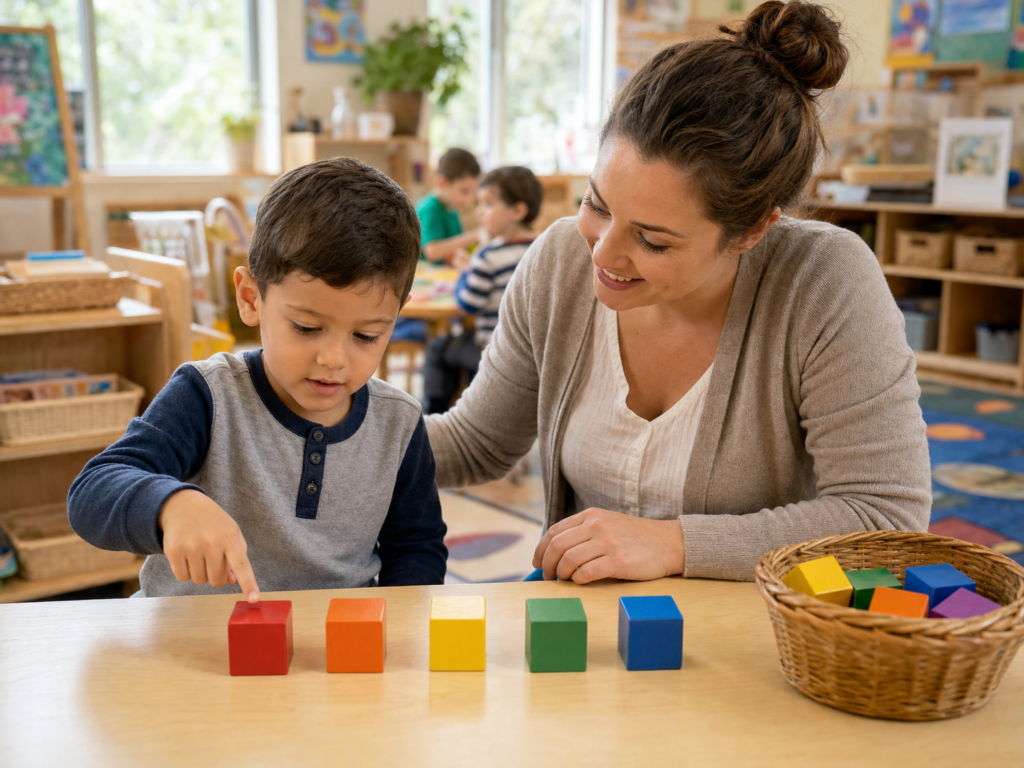
Counting skills for kids begin long before children solve their first addition problem.
A young child may proudly count, “one, two, three, four, five,” but learning the number sequence is only one part of early mathematics. Children also need to understand that numbers represent actual quantities.
Five blocks are five blocks whether they are lined up neatly, scattered across a table, or stacked into a tower.
That understanding is part of number sense, and it provides an important foundation for the math children will encounter in Kindergarten, first grade, and beyond.
The good news for parents is that building early number sense does not require complicated lessons.
Blocks, buttons, toy animals, crayons, snacks, steps, socks, and countless other everyday objects can become simple opportunities to count, compare, organize, and explore numbers.
The goal is not to push young children into formal arithmetic early.
It is to help numbers begin to make sense.
Counting Is More Than Saying Numbers in Order
Many children learn number words much like they learn the words to a familiar song.
“One, two, three, four, five…”
Being able to recite those words is useful. It means the child is learning the sequence of numbers.
But consider a different task.
Place five blocks on a table and ask:
“How many blocks are here?”
Now the child has to do more than remember a sequence.
The learner must connect each spoken number with an object and understand that the final number tells how many objects are in the entire group.
That is a much richer mathematical idea.
A child can therefore be quite good at reciting numbers while still developing an understanding of quantity.
Both skills matter.
Build One-to-One Correspondence
One of the most important early counting skills for kids is learning to count each object exactly once.
Educators often call this one-to-one correspondence.
Imagine six blocks arranged on a table.
A child touches the first block and says “one,” touches the second and says “two,” and continues until every block has been counted once.
It sounds simple, but it requires coordination between what the child sees, what the hand touches, and what the child says.
Young learners may sometimes:
- Skip an object
- Count the same object twice
- Say number words faster than they point
- Lose track of which objects have already been counted
Physical objects make this skill easier to practice.
Try placing a small collection of objects on the table and have your child move each one from one side to the other while counting.
One object moves.
One number is said.
Then another object moves.
Another number is said.
This physical action makes it easier to see which objects have already been counted.
Help Children Understand That the Last Number Is the Total
Suppose your child counts five toy cars correctly:
“One, two, three, four, five.”
Then you ask:
“How many cars are there?”
And the child begins counting them all over again.
That is not unusual.
The child may know how to perform the counting sequence without fully understanding that the final number, five, represents the total quantity.
You can reinforce this idea naturally.
After counting, say:
“You counted five cars. There are five cars altogether.”
Then change the arrangement.
Spread the same five cars farther apart and ask again.
Are there still five?
Move them close together.
Still five?
This helps the child understand that quantity remains the same even when the arrangement changes.
That idea will become increasingly important as mathematics becomes more complex.
Practice Counting Real Objects
Early counting becomes more meaningful when children can touch and move what they are counting.
Hands-on exploration is especially valuable in early mathematics because young children can develop number concepts by sorting, counting, comparing, and talking about real objects.
You do not need specialized math materials.
Try:
- Building blocks
- Toy animals
- Crayons
- Buttons
- Craft sticks
- Socks
- Plastic cups
- Small balls
- Toy cars
- Safe household objects
Begin with small quantities.
Ask your child to place three blocks on the table.
Then four.
Then five.
Reverse the activity by placing a group of objects on the table and asking how many there are.
The important part is connecting the spoken number with the physical quantity.
As confidence grows, gradually increase the number of objects.
Build Number Recognition Alongside Counting
Children eventually need to connect three different ideas:
The spoken word: “five”
The written symbol: 5
The quantity: five actual objects
These connections develop through repeated experiences.
For example, place five blocks on a table.
Count them together.
Then show the numeral 5.
Say:
“This number is five. We have five blocks.”
You can create simple numeral cards from index cards or pieces of paper.
Place several cards on the table and ask your child to match a quantity to the correct numeral.
If the card shows 4, the child can place four blocks underneath it.
Now the written symbol has a concrete meaning.
Use Small Groups to Develop Quick Number Recognition
As children gain experience with quantities, they may begin recognizing very small groups without counting every object individually.
For example, an adult usually does not need to count three dots arranged on a card. We recognize the quantity almost immediately.
This ability is often called subitizing.
You can encourage it through simple activities.
Place two or three objects on the table.
Ask:
“How many do you see?”
Later, try four or five.
Dot cards can also work well. So can familiar patterns on dice or dominoes.
Do not turn speed into the objective.
The purpose is to help children become increasingly familiar with what small quantities look like.
That visual understanding can later support addition and subtraction.
Compare Groups: More, Less, and the Same
Counting helps children determine how many objects are in a group.
Comparing helps them understand relationships between groups.
Place two blocks on one side of a table and five on the other.
Ask:
“Which group has more?”
Then:
“Which group has fewer?”
Try groups with the same number.
“Are these the same?”
As your child becomes comfortable, make the differences less obvious.
Instead of comparing two objects with eight, compare four with five.
Encourage the child to count when the answer is not immediately clear.
Use mathematical language naturally:
- More
- Fewer
- Same
- Equal
- Greater
- Smaller group
- Larger group
These words help children describe what they are seeing and thinking.
Show That Spacing Does Not Change Quantity
Young children may sometimes judge quantity by how much space a group occupies.
Imagine placing five blocks tightly together.
Next to them, place four blocks with large spaces between them.
The four-block row may appear longer.
Ask:
“Which group has more?”
Then count both groups.
This provides an opportunity to discover that a group can take up more space without containing more objects.
Try rearranging the same group in several ways.
Put five counters in a straight row.
Then arrange those same five in a circle.
Then scatter them.
Ask each time:
“How many are there now?”
The answer remains five.
These simple experiments strengthen number sense because children begin separating how a group looks from how many objects it actually contains.
Count Forward From Different Numbers
Children often practice counting beginning with one.
That is important, but eventually they should also experience starting from other numbers.
Ask:
“What comes after four?”
Or begin:
“Six, seven…”
and invite your child to continue.
You can turn this into a simple game.
Say a number and roll a ball to your child.
The child says the next number and rolls it back.
As the skill develops, try continuing for several numbers.
Starting from different points helps children understand the number sequence as a connected system rather than something that always begins at one.
Introduce Backward Counting Through Play
Backward counting gives children another way to explore how numbers relate to one another.
Keep it simple at first.
Start with five:
“Five, four, three, two, one…blast off!”
Children often enjoy the anticipation of a countdown.
Use toys as another option.
Place five toy animals on the table.
Remove one at a time while counting backward:
“Five…four…three…two…one.”
The child is beginning to experience the idea that quantities can decrease.
There is no need to formally introduce subtraction terminology if the child is not ready.
The experience itself is valuable.
Explore the Idea of One More and One Less
Once children can count small groups reliably, begin asking questions that encourage them to think about changing quantities.
Place four blocks on the table.
“How many blocks?”
Four.
Add one.
“How many now?”
Count if necessary.
Then say:
“We had four. One more made five.”
Try the reverse.
Begin with five blocks.
Remove one.
“How many are left?”
These small activities begin building an intuitive understanding of addition and subtraction without requiring formal equations.
The child is experiencing what happens when a quantity increases or decreases.
Use Everyday Routines for Counting Practice
Some of the best opportunities for developing counting skills for kids occur during ordinary family routines.
At breakfast:
“Can you put four strawberries on your plate?”
While getting dressed:
“How many socks do you need?”
Setting the table:
“We need one spoon for each person. How many spoons should we get?”
Cleaning up:
“Can you put five blocks in the box?”
Walking upstairs:
“Let’s count the steps.”
At the grocery store:
“Can you put three apples in the bag?”
These activities make numbers useful.
Children are not counting because an adult assigned a worksheet.
They are counting because the number helps them accomplish something.
That connection can make early mathematics feel natural and relevant.
As children become more comfortable counting and comparing quantities, everyday experiences can also introduce them to counting money and recognizing coins.
Use Sorting to Strengthen Early Math Thinking
Sorting may not look like counting, but the two activities work very well together.
Give your child a mixed collection of safe objects.
Perhaps there are red, blue, and yellow blocks.
First, sort them by color.
Then count each group.
“How many red blocks?”
“How many blue blocks?”
“Which color has more?”
Now a simple sorting activity has incorporated classification, counting, and comparison.
You can sort objects by:
- Color
- Shape
- Size
- Type
- Texture
Then count the groups.
This helps children notice attributes while strengthening their understanding of quantity.
Introduce Simple Patterns
Patterns are another important part of early number sense.
Begin with something easy:
Red block, blue block, red block, blue block.
Ask:
“What comes next?”
Later try:
Red, red, blue, red, red, blue.
Children begin recognizing that mathematics contains predictable relationships.
You can make patterns with blocks, beads, shapes, movements, sounds, or household objects.
Clap, tap, clap, tap.
Step, step, jump. Step, step, jump.
These playful experiences strengthen the ability to notice and predict patterns, an important habit in mathematical thinking.
What About Skip Counting?
Skip counting can be introduced gradually when a child has a comfortable understanding of ordinary counting and quantities.
Counting by twos can begin with pairs.
Two shoes.
Two mittens.
Two eyes.
Arrange objects in pairs and count:
2, 4, 6.
Counting by fives can connect naturally to fingers.
Five fingers on one hand.
Ten fingers on two hands.
The purpose at this stage is exposure, not mastery.
If a child finds skip counting confusing, return to regular counting and grouping.
There is no need to rush.
Strong understanding is more important than moving quickly to the next skill.
Combine Hands-On Activities With Printable Practice
Hands-on activities are particularly valuable when children are first developing number concepts.
A child can physically place four blocks beneath the numeral 4 or move six counters while counting them one at a time.
Printable activities can then reinforce those same ideas.
For example, after practicing quantities with blocks, a child might complete a page that asks them to count groups of pictured objects.
The physical experience provides meaning.
The printable activity provides additional practice.
Used together, they can support both understanding and independence.
Keep Early Math Sessions Short
Young children do not need long formal math sessions.
Five or ten focused minutes can accomplish a great deal.
Count a few objects.
Compare two groups.
Make a pattern.
Match quantities with numerals.
Then move on.
Tomorrow, do something slightly different.
Frequent, positive encounters with numbers are more important than trying to cover many concepts in one sitting.
Watch your child’s engagement.
If frustration begins replacing curiosity, the activity may be too difficult, too long, or simply poorly timed.
You can return to it later.
Let Children Explain What They Notice
One of the easiest ways to encourage mathematical thinking is to ask children to explain.
Instead of only asking:
“How many?”
also try:
“How did you figure that out?”
“What do you notice?”
“Which group has more? How do you know?”
“What would happen if we added another one?”
“Can you make a group with the same number?”
There does not need to be a sophisticated answer.
The value comes from encouraging the child to think about relationships rather than simply provide a correct response.
Avoid Turning Every Mistake Into a Correction
Suppose your child counts six blocks and says there are seven.
Instead of immediately saying, “No, that’s wrong,” try:
“Let’s count them together.”
Then touch each block once.
One.
Two.
Three.
Four.
Five.
Six.
“How many did we find?”
This approach turns an error into another opportunity to observe the counting process.
You may discover that the child knows the sequence perfectly but counted one block twice.
Or perhaps one object was skipped.
Understanding where the counting broke down is more useful than simply identifying an incorrect answer.
When Counting Skills Develop at Different Speeds
Children do not all develop early math skills on the same timetable.
One child may recognize written numerals quickly but struggle to count objects accurately.
Another may be excellent at comparing quantities but still reverse some written numbers.
Another may count objects confidently but have difficulty explaining which group has more.
Look for progress rather than expecting every skill to develop simultaneously.
If you have ongoing concerns about your child’s math development or notice persistent difficulty with skills being taught in class, your child’s teacher can be an especially useful resource.
Teachers can explain what they are observing at school, what skills the class is currently developing, and which kinds of practice may be most useful at home.
That partnership can help parents focus practice on what the child actually needs.
If you are unsure how to begin that conversation, our guide to talking with your child’s teacher about math struggles offers practical questions and ideas for working together.
Build Number Sense Before Rushing Into Arithmetic
It can be tempting to move quickly from counting into addition problems.
But a strong understanding of quantity makes later arithmetic easier to understand.
Before worrying about how many addition facts a young child can complete, give the learner plenty of opportunities to explore questions such as:
How many?
Which has more?
Which has fewer?
Are these the same?
What happens if we add one?
What happens if we take one away?
Can you make another group with five?
Can you arrange five objects differently?
These questions develop the relationships that arithmetic eventually expresses with symbols.
Counting Skills for Kids Grow Through Everyday Experiences
Building early number sense does not require turning your home into a classroom.
It requires opportunities.
Count the crayons.
Match socks.
Compare two groups of crackers.
Make a pattern with blocks.
Count stairs.
Put four plates on the table.
Find three toy cars.
Arrange five objects in different ways.
Ask what happens when you add one more.
Through experiences like these, children begin discovering that numbers are not simply words printed on a page.
Numbers describe their world.
And that is the real foundation of early mathematics.
When counting skills for kids develop alongside number sense, children begin moving from simply saying numbers to understanding what those numbers actually mean.
Start small.
Choose a few objects your child already enjoys.
Put them on the table.
And count together.
Frequently Asked Questions
What is number sense for young children?
Number sense is a developing understanding of numbers, quantities, and their relationships. It includes ideas such as recognizing how many objects are in a group, comparing quantities, understanding one more and one less, and connecting written numerals with actual amounts.
What is the difference between counting and number sense?
Counting often begins with learning number words in sequence. Number sense goes further by helping a child understand what those numbers represent. A child may be able to say “one through ten” before being able to accurately count ten individual objects.
How can I practice counting at home?
Use everyday objects. Children can count blocks, crayons, toy cars, socks, snacks, steps, or items being put away. Short counting activities built into ordinary routines can provide plenty of meaningful practice.
What is one-to-one correspondence?
One-to-one correspondence means matching one number word to one object while counting. If a child counts six blocks, each block should be counted exactly once. Touching or moving each object can make this easier for young learners.
Should Kindergarten children practice counting backward?
Backward counting can be introduced playfully with small numbers. A countdown from five is an easy place to begin. It helps children experience the number sequence in another direction and prepares them for thinking about decreasing quantities.
Should young children use math worksheets?
Printable activities can be useful, especially when they reinforce concepts children have already explored with real objects. For early learners, combining hands-on experiences with simple, age-appropriate printable practice can work particularly well.
How long should Kindergarten math practice last at home?
There is no need for lengthy sessions. A few focused minutes of counting, sorting, comparing, or pattern work can be productive. The quality of the interaction and the child’s engagement matter more than extending the activity for a particular amount of time.
Continue Exploring Math Help & Guidance
Explore more Math Help & Guidance from Encouraging Math for practical strategies, teaching ideas, and clear explanations designed to make math easier to understand and practice.