
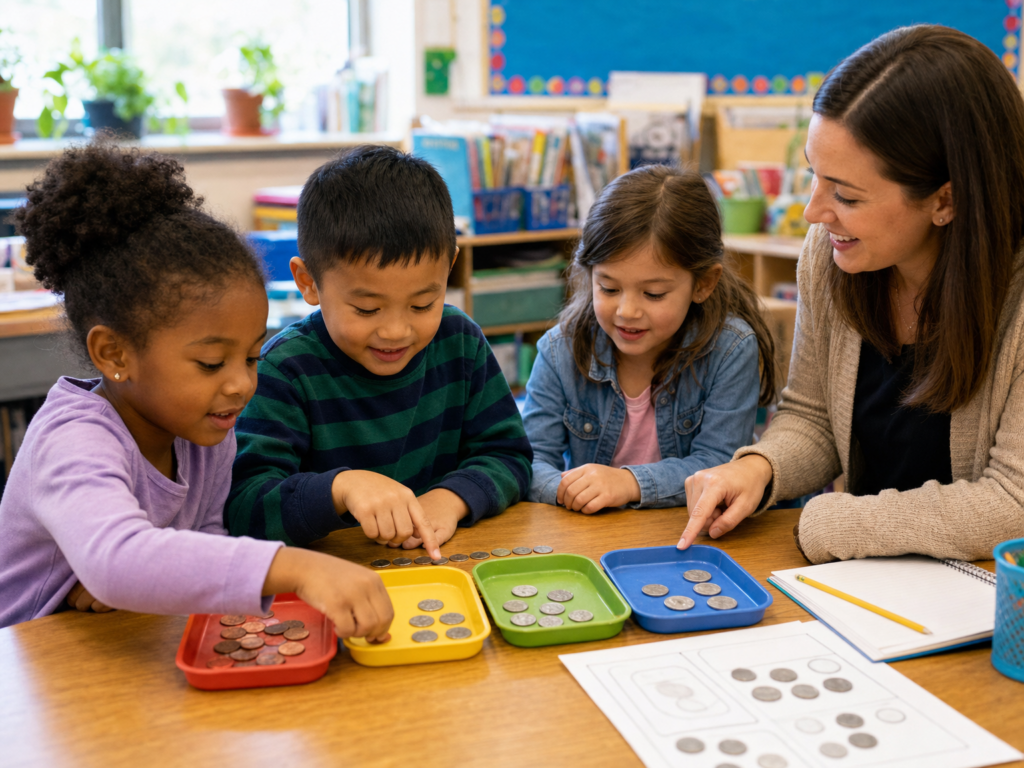
Teaching kids about money is about much more than memorizing that a penny is worth one cent or a quarter is worth twenty-five cents.
For young learners, money provides an opportunity to connect numbers with something they can see, touch, sort, compare, and count.
That makes learning about coins especially useful during the early elementary years.
Children in Grades 1 and 2 are developing important skills such as addition, subtraction, skip counting, comparing numbers, and solving simple word problems. Coin activities can reinforce many of these skills while giving children a practical reason to use them.
But learning to count money can also be surprisingly challenging.
A larger coin is not necessarily worth more. Different combinations of coins can have the same value. And counting mixed coins requires children to change counting patterns as they work.
The solution is not to introduce everything at once.
Instead, help children build understanding one step at a time.
Why Teaching Kids About Money Builds Important Math Skills
Money gives numbers meaning.
A child can memorize that 5 + 5 = 10. But when two nickels are placed beside a dime, that same relationship becomes something the child can physically observe.
Coin activities can reinforce several early math skills:
- Number recognition
- Counting
- Skip counting
- Addition
- Subtraction
- Comparing values
- Grouping
- Equivalence
- Problem solving
These connections are one reason money can be such a useful early math topic.
The goal, however, should not be to rush children toward complicated money problems.
Start by helping them understand what the coins represent.
Begin With Coin Recognition
Before asking a child to count a group of mixed coins, make sure the individual coins are familiar.
Use a small collection of pennies, nickels, dimes, and quarters.
Let your child examine them.
Talk about the differences.
Which coin is largest?
Which is smallest?
Which coins have smooth edges?
Which have ridged edges?
Which look similar?
Then introduce the names and values.
A child should gradually become familiar with these basic relationships:
- Penny = 1 cent
- Nickel = 5 cents
- Dime = 10 cents
- Quarter = 25 cents
Do not worry if your child does not remember everything immediately.
Recognition develops through repeated exposure.
A quick coin-sorting activity today, another tomorrow, and a short counting activity later in the week can be more productive than trying to master everything in one sitting.
Parents who want to explore coins in more detail can also use the U.S. Mint’s educational resources for children to reinforce coin recognition and basic money concepts.
Help Children Understand That Size Does Not Determine Value
Coins introduce an unusual idea for young learners:
Bigger does not always mean more.
A nickel is physically larger than a dime, but a dime is worth twice as much.
A penny is larger than a dime but worth much less.
This can seem strange to a child whose previous number experiences often reinforced the idea that larger quantities look bigger.
Rather than simply telling your child to memorize the values, compare the coins directly.
Place a nickel and dime next to each other.
Ask:
“Which coin is bigger?”
Then:
“Which coin is worth more?”
That simple comparison helps separate physical size from mathematical value.
It is an important distinction that will appear again in other areas of mathematics.
Sort Coins Before Counting Them
Sorting is an excellent bridge between recognizing coins and counting them.
Place a small group of mixed coins on a table.
Ask your child to put all the pennies together, all the nickels together, all the dimes together, and all the quarters together.
At first, focus entirely on sorting.
Then ask your child to name each group.
Later, add the values:
“These are nickels. How much is each nickel worth?”
This reduces the amount of information the learner has to process at once.
Instead of trying to recognize a coin, remember its value, and count a mixed collection simultaneously, the child practices each part separately.
As recognition becomes easier, counting can become the next focus.
Connect Coins to Skip Counting
Money provides a natural reason to practice skip counting.
Pennies are counted by ones.
Nickels can be counted by fives:
5, 10, 15, 20, 25…
Dimes can be counted by tens:
10, 20, 30, 40, 50…
Quarters introduce counting by twenty-fives:
25, 50, 75, 100.
You do not need to teach all of these sequences at the same time.
If your child is learning to count by fives, nickels provide an excellent concrete model.
Place four nickels in a row.
Point to each coin while counting:
5…10…15…20.
Then mix up the coins and arrange them again.
The total remains 20 cents.
This helps children see that skip counting is not merely a sequence they recite. It represents equal groups.
As children become more comfortable with skip counting, that same number-pattern awareness can support later skills such as multiplication fluency.
Count Groups of the Same Coin First
Before introducing mixed coins, practice counting groups containing only one type.
For example:
- 7 pennies
- 4 nickels
- 6 dimes
- 3 quarters
This allows the child to concentrate on one counting pattern at a time.
If four nickels are on the table, the learner can count:
5, 10, 15, 20.
Once this becomes comfortable, ask questions such as:
“How much would one more nickel make?”
“What if we took one nickel away?”
“How many nickels would we need to make 30 cents?”
Now the activity begins connecting coin values with addition, subtraction, and number relationships.
Introduce Mixed Coins Gradually
Mixed coins require more thinking.
A learner may begin counting dimes by tens and then need to switch to counting nickels by fives and pennies by ones.
That is a significant mental step.
Start with only two types of coins.
For example, use dimes and pennies.
Two dimes and three pennies can be counted:
10, 20, 21, 22, 23.
Then try nickels and pennies.
Once your child is comfortable changing counting patterns, introduce additional combinations.
A useful strategy is to organize the coins before counting.
Rather than counting a random pile from left to right, encourage your child to group similar coins together and begin with the higher-value coins.
This turns what initially looks like a confusing collection into a more organized math problem.
Show That Different Coins Can Have the Same Value
This is one of the most important concepts in teaching kids about money.
Different groups of coins can represent the same amount.
Five pennies have the same value as one nickel.
Two nickels have the same value as one dime.
Five nickels have the same value as one quarter.
Two dimes and one nickel also equal one quarter.
These relationships introduce the idea of equivalence.
Try a simple trading game.
Place five pennies on the table and ask:
“Can we trade these for one coin with the same value?”
Replace them with a nickel.
Then place two nickels on the table.
“What single coin could replace these?”
A dime.
These exchanges help children understand value rather than simply memorize coin names.
Use a Simple Home Store
Once your child recognizes and counts coins, create opportunities to use them.
A pretend store is one of the easiest activities.
Choose several familiar objects such as pencils, erasers, small toys, or index cards representing pretend products.
Give each item a simple price appropriate for your child’s current skills.
If your child is just beginning, keep amounts small.
Then provide a collection of coins and ask the child to “buy” something.
The learner must decide which coins can make the correct amount.
This adds purpose to the counting.
Instead of:
“Count these coins.”
The question becomes:
“Can you make 20 cents?”
Later:
“Can you find another way to make 20 cents?”
Now the child is exploring multiple combinations and developing flexible number sense.
Connect Money With Addition and Subtraction
When teaching kids about money, simple addition and subtraction activities can help connect coin values with arithmetic children are already learning.
Money can also make early addition and subtraction more concrete.
Suppose a child has 15 cents and receives another nickel.
Rather than immediately writing:
15 + 5 = 20
let the learner model it with coins first.
Then write the equation.
This sequence helps connect the physical experience to the mathematical notation.
The same approach works with subtraction.
Start with 25 cents.
Remove a nickel.
How much remains?
Once the child determines the answer using the coins, connect it to:
25 − 5 = 20
Concrete experience can support the transition toward solving the same problems mentally or on paper.
Introduce Simple Money Word Problems
Money is a natural setting for early word problems because children understand the basic idea of buying something.
Keep the situations simple.
For example:
“Lena has 15 cents. Her grandfather gives her another 10 cents. How much does she have now?”
Or:
“A pencil costs 20 cents. You have two dimes. Do you have enough?”
Ask your child to model the situation with coins before solving it on paper.
This helps connect the language of the problem to the operation.
For learners who struggle with word problems, the ability to physically represent the situation can make the reasoning easier to see.
Use Everyday Opportunities Without Turning Everything Into a Lesson
One advantage of teaching kids about money is that practice opportunities naturally appear in everyday life.
You can take advantage of those moments without turning every trip to the store into a math assignment.
Let your child examine coins from your pocket or change jar.
Ask for help sorting them.
Occasionally ask:
“Can you find a dime?”
Or:
“Can you show me two different ways to make 10 cents?”
Small questions provide practice without creating pressure.
As children become more confident, you can introduce more challenging questions.
“How could we make 30 cents?”
“Can you make 30 cents another way?”
“Which is more, three nickels or two dimes?”
These quick conversations build mathematical thinking into normal routines.
Combine Hands-On Learning With Printable Practice
Physical coins are excellent for introducing concepts because children can manipulate and compare them directly.
Printable practice serves a different purpose.
Once a learner understands what the coins represent, worksheets can help reinforce recognition, counting, addition, and problem-solving skills.
The two approaches work well together.
For example:
- Model a coin combination with real coins.
- Count the value together.
- Complete several similar problems on paper.
- Return to physical coins if confusion appears.
This allows hands-on learning to build understanding while written practice develops independence.
Neither approach needs to replace the other.
A balanced approach to teaching kids about money can combine hands-on exploration with focused printable practice.
Watch for Common Money-Math Difficulties
Children may struggle with counting money for several different reasons.
Confusing coin names
Return to sorting and recognition activities before asking the child to calculate values.
Forgetting coin values
Use small groups and repeated comparisons rather than introducing more complicated problems.
Difficulty with skip counting
Practice the appropriate number sequence separately, then reconnect it to the coins.
Losing track while counting mixed coins
Sort the coins first and encourage the child to count systematically.
Difficulty understanding equivalent amounts
Use physical trades, such as exchanging five pennies for a nickel.
Trouble with money word problems
Model the situation with coins before expecting the learner to solve it abstractly.
Finding the specific point of difficulty makes practice much more useful.
Do Not Rush to Dollars and Decimal Notation
Young learners already have plenty to think about when learning coin values.
Adding dollar signs and decimal notation too early can introduce another layer of complexity.
A child can understand that two dimes and a nickel equal 25 cents before needing to write $0.25.
Build the concept first.
Once coin values and counting are comfortable, connect cents to dollars and decimal notation as appropriate for the learner’s level.
This gradual progression helps children understand what the notation represents rather than treating it as another rule to memorize.
Keep Money Practice Short and Positive
When teaching kids about money, short and successful practice sessions are often more useful than trying to cover too much at once.
Early math practice does not need to last a long time.
Ten productive minutes sorting and counting coins can be more valuable than a long session that ends in frustration.
Stop while your child is still engaged.
Celebrate specific progress:
“You recognized every nickel today.”
“You counted those dimes without help.”
“You found two different ways to make 25 cents.”
“You noticed that the dime is smaller but worth more.”
Specific encouragement tells children exactly what they are learning to do successfully.
What Should First and Second Graders Know About Money?
There is no need to turn money skills into a race.
Children develop at different rates, and classroom expectations can vary.
During the early elementary years, useful goals generally include becoming increasingly comfortable with:
- Recognizing common coins
- Knowing basic coin values
- Sorting coins
- Counting groups of the same coin
- Skip counting by useful intervals
- Counting increasingly varied coin combinations
- Comparing simple amounts
- Finding different ways to make the same amount
- Solving simple addition and subtraction situations involving money
A learner does not need to master all of these simultaneously.
Build from the skills your child already understands.
Teaching Kids About Money Is Really About Building Number Sense
Coins are useful because they bring several mathematical ideas together.
Children classify objects.
They count.
They skip count.
They compare.
They add and subtract.
They discover that different combinations can represent equal values.
They solve practical problems.
And gradually, an abstract idea such as “25” becomes something they can represent in several different ways.
That is the larger goal of teaching kids about money.
We are not simply teaching children to identify coins.
We are helping them understand numbers, relationships, and value.
Start small.
Put a few coins on the table.
Sort them.
Name them.
Count them.
Trade one combination for another.
Then build from there.
Those simple activities can turn money into a practical and engaging way to strengthen early math skills.
Frequently Asked Questions
What age should children start learning about coins?
Children can become familiar with coins before they are ready to count their values. During the early elementary years, coin recognition and counting can become part of broader work with number sense, addition, subtraction, and skip counting. Readiness matters more than reaching a particular skill by an exact age.
Should I teach all four common coins at once?
Not necessarily. If your child becomes confused, introduce fewer coin types and build familiarity gradually. Once the child recognizes the coins and understands their individual values, begin combining them.
Are real coins better than worksheets for learning money?
They serve different purposes. Real coins allow children to sort, compare, trade, and physically model amounts. Well-designed printable practice can then reinforce the same concepts and help children work independently. Using both can provide a strong combination.
Why does my child struggle with mixed coins?
Mixed coins require several skills at once. The learner must recognize each coin, remember its value, change counting patterns, and keep track of a running total. Return to counting groups of the same coin and then introduce mixed combinations gradually.
How can I help my child understand that a dime is worth more than a nickel?
Place the coins side by side and discuss both their physical size and their mathematical value. Then use equivalent groups, such as two nickels beside one dime. Seeing that both represent 10 cents helps children understand that coin size does not determine value.
How can I make counting money more interesting?
Use short sorting games, coin trades, pretend stores, “make this amount” challenges, and everyday opportunities. Keep activities brief and adjust the difficulty so the child experiences both thinking and success.
Continue Exploring Math Help & Guidance
Explore more Math Help & Guidance from Encouraging Math for practical strategies, teaching ideas, and clear explanations designed to make math easier to understand and practice.