
Children experience time very differently from adults. Twenty minutes of play can seem to disappear instantly, while five minutes spent getting dressed can somehow feel endless.
That difference can make mornings, homework, chores, and bedtime frustrating for everyone. A parent sees the clock moving and knows exactly what needs to happen next. A child may be completely absorbed in what is happening right now.
Children do not automatically understand how long tasks take, how to plan backward from a deadline, or how to prioritize several things that need to be done. Those abilities develop gradually.
That is why time management skills for kids are best treated as learned skills rather than something children should simply know how to do.
Instead of repeatedly telling children to hurry, parents can help them understand what time means, recognize how long activities take, and gradually learn to manage routines themselves.
The goal is not to create children who live according to rigid schedules. It is to give them tools that help them become more aware, organized, and independent.
Make Time Something Children Can See
Adults have years of experience connecting numbers on a clock with real activities.
Children do not.
When you tell a young child, “We’re leaving in ten minutes,” the number may have very little meaning. Ten minutes is invisible.
One of the easiest ways to begin teaching time awareness is to make time more visible.
An analog clock can help because children can watch the hands move. Instead of simply announcing a time, connect the clock to an action.
“When the big hand reaches the six, we need to leave.”
“When the minute hand reaches the twelve, it will be time to start getting ready for bed.”
Visual timers can be useful for the same reason. Timers that display a shrinking section as time passes allow children to actually see their remaining time getting smaller.
Try using one for ordinary activities:
- Ten minutes to finish playing before cleanup
- Fifteen minutes for part of a homework assignment
- Five minutes to get shoes and a coat
- Twenty minutes of reading
- Ten minutes to straighten a bedroom
The purpose is not to race through everything. The timer is simply helping the child connect an amount of time with an actual experience.
Eventually, “ten minutes” begins to mean something.
Use Predictable Routines to Reduce Reminders
Time management becomes easier when children do not have to constantly decide what happens next.
A predictable morning routine might be:
Get dressed.
Eat breakfast.
Brush teeth.
Put on shoes.
Grab backpack.
An after-school routine might include:
Snack.
Unpack backpack.
Homework.
Chores.
Free time.
The exact routine will depend on your household. What matters is that children begin recognizing a sequence.
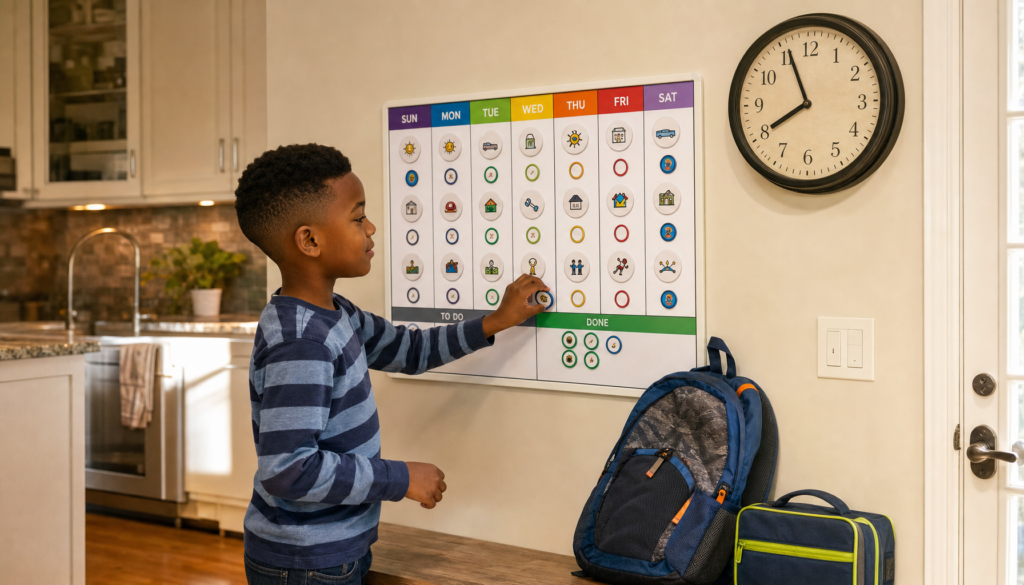
A visual checklist can make the routine even more effective. Younger children might use pictures, while older children can use written lists.
Then something important can begin to happen.
Instead of saying:
“Go brush your teeth.”
“Now find your shoes.”
“Did you get your backpack?”
“Where is your lunch?”
You can ask:
“What comes next?”
The checklist becomes the reminder rather than the parent.
That small change begins transferring responsibility to the child.
Teach Children to Estimate How Long Things Take
Understanding time requires more than reading a clock. Children also need experience estimating duration.
You can practice this during everyday activities.
Ask:
“How long do you think it will take to put away these toys?”
“Do you think you can get dressed in five minutes or will you need ten?”
“How long do you think it takes us to drive to soccer practice?”
Write down the prediction or simply remember it. Then time the activity.
The objective is not to catch the child being wrong.
You are helping them build an internal sense of duration.
A child may predict that cleaning a bedroom takes five minutes and discover it actually takes twenty-five. That discovery is useful.
The next time the child plans the afternoon, “clean my room” no longer looks like a five-minute task.
Time estimation can even become a family game. Before a car trip, everyone can guess how long the drive will take. Before preparing dinner, estimate how much time is needed. Guess how long it takes to unload the dishwasher or fold a basket of laundry.
Ordinary activities become opportunities to practice time management skills for kids without turning the lesson into another assignment.
Break Larger Tasks Into Time Blocks
Children can easily become overwhelmed by assignments that feel large or undefined.
“Clean your room” can seem enormous.
“Finish your project” offers no obvious starting point.
Breaking the task into smaller blocks makes both the work and the time easier to understand.
Instead of:
Clean your room.
Try:
Put toys away: 10 minutes
Put books on shelves: 5 minutes
Put clothes in the hamper: 5 minutes
Homework can work the same way:
Math worksheet: 15 minutes
Reading: 20 minutes
Spelling practice: 10 minutes
The estimates do not need to be perfect.
In fact, discovering that something took longer or less time than expected is part of the lesson.
As children gain experience, they begin breaking tasks into smaller pieces themselves. What initially required a parent’s help gradually becomes an independent planning skill.
Teach Kids to Plan Backward
Planning backward is one of the most useful time-management habits children can learn.
Start with something familiar.
Suppose soccer practice begins at 5:30.
Ask:
“What time do we need to leave?”
If the answer is 5:10, continue working backward.
“What needs to happen before we leave?”
Change clothes.
Fill the water bottle.
Find the soccer equipment.
Use the bathroom.
Now ask:
“If all of that takes about twenty minutes, when should you start getting ready?”
Suddenly, the starting time has a reason behind it.
The same approach works with bedtime.
If lights are out at 8:30, children can work backward through reading, brushing teeth, pajamas, and getting ready for the next morning.
Older children can use backward planning for school assignments.
If a project is due Friday, ask:
“What needs to be finished by Thursday?”
“What should you work on Wednesday?”
“What could you start today?”
A deadline stops being a single date in the future and becomes a series of manageable steps.
Use Simple Schedules and Checklists
Children do not need complicated productivity systems.
A short checklist is often enough.
For example:
After School
Snack
Unpack backpack
Check assignments
Complete homework
Pack materials for tomorrow
Free time
A weekend list might contain only three priorities.
The important part is giving the child something they can consult without asking a parent what to do next.
Whenever possible, involve children in creating their schedules.
Ask:
“What do you need to get done after school?”
“What order makes the most sense?”
“What do you want to finish before you play?”
Children are more likely to understand and use a plan they helped create.
It also changes their role. They are no longer simply following instructions. They are beginning to make decisions about how their time will be used.
Gradually Reduce Your Reminders
This may be the hardest part.
Once parents become accustomed to reminding children about everything, it can be difficult to stop.
But constant reminders can unintentionally teach children to wait for the next instruction.
Instead of:
“Put your shoes on.”
Try:
“What do you still need to do before we leave?”
Instead of:
“Start your homework.”
Try:
“What does your after-school plan say comes next?”
Instead of:
“Don’t forget your library book.”
Try:
“Is everything ready for tomorrow?”
These questions require the child to think.
You are still providing support, but you are no longer supplying every answer.
Start with one routine rather than changing everything at once. Morning preparation or bedtime may be a good place to begin.
As your child becomes more capable, reduce the number of prompts.
The ultimate goal is not a child who follows parental reminders perfectly. It is a child who increasingly remembers without needing them.
Use Poor Planning as a Learning Opportunity
Some days will not go according to plan.
A child will underestimate how long homework takes.
Someone will forget a backpack.
A project may get started much too late.
These moments can teach more than a perfectly executed schedule.
Once everyone is calm, review what happened.
Ask:
“What took longer than you expected?”
“Where did the plan start getting off track?”
“What could you do differently tomorrow?”
“Was there something we forgot to include in the schedule?”
Avoid turning the review into a lecture.
The purpose is to help children connect choices, time, and outcomes.
Suppose your child started a school project Thursday evening even though it was due Friday morning.
Instead of focusing only on the late start, examine the planning.
“When did you first know about the project?”
“What steps did it require?”
“When could you have started the first step?”
“What would make this easier next time?”
Now the mistake becomes information.
That ability to review and adjust is an important part of becoming an independent planner.
Make Time Awareness Part of Family Life
Time management does not have to be taught only when something goes wrong.
Families can practice it naturally.
A short weekly planning session can be especially helpful.
Take ten or fifteen minutes to look at the week ahead.
What school activities are coming?
Are there practices, appointments, projects, or family plans?
Which days look especially busy?
Does anything need to be prepared ahead of time?
Let children participate according to their age.
A younger child might identify soccer practice on the calendar. An older child might recognize that a book report and a sports practice fall on the same evening and decide to begin the report earlier.
You can also continue using estimation games.
“How long do you think this drive will take?”
“How much time should we allow to get ready?”
“Can we finish cleaning the kitchen in fifteen minutes?”
These small conversations help children develop a more realistic understanding of time.
Independence Is the Real Goal
Teaching time management skills for kids is not about filling every minute of a child’s day.
Children need free time, play, creativity, rest, and opportunities to simply be children.
Time management is about helping them understand that activities take time, choices affect schedules, and planning can make life easier.
At first, parents provide most of the structure.
You create the routine.
You point to the clock.
You help estimate the time.
You ask what comes next.
Gradually, the child begins taking over those responsibilities.
They check the schedule.
They recognize when it is time to get ready.
They estimate how long homework might take.
They remember what needs to go into the backpack.
They adjust when a plan does not work.
Structured practice can reinforce these skills too. Routine charts, weekly planners, time-estimation activities, reflection exercises, and time-awareness workbooks can give children additional opportunities to practice planning in a clear and manageable way.
The change will not happen perfectly or all at once.
But every time a child looks at the clock and thinks, “I should probably start getting ready,” instead of waiting for someone to tell them, something important has happened.
They are not simply learning to manage time.
They are learning to manage themselves.