
Place value for kids can seem simple to adults, but it represents an important shift in mathematical thinking. A child may be able to count to 100, recognize two-digit numbers, and even complete basic addition problems while still not fully understanding what the digits in those numbers actually represent.
Consider the number 47.
A child may correctly say “forty-seven,” but understanding 47 means recognizing that the 4 represents four tens, not simply the number four. The 7 represents seven ones. Together, those quantities make 47.
That distinction becomes increasingly important as children move into addition, subtraction, regrouping, multiplication, decimals, and eventually more advanced mathematics.
The good news is that place value does not have to begin as an abstract concept. With physical objects, visual models, simple conversations, and carefully chosen practice, children can develop a strong understanding of how our number system works.
What Is Place Value for Kids?
Place value describes how the position of a digit determines its value.
In the number 352:
- The 3 is in the hundreds place and represents 300.
- The 5 is in the tens place and represents 50.
- The 2 is in the ones place and represents 2.
The same digit can therefore represent very different quantities depending on where it appears.
For example, look at the digit 6:
6 = six ones
60 = six tens
600 = six hundreds
The digit itself has not changed. Its position has changed, and that changes its value.
This is one of the fundamental ideas children need to understand about our base-ten number system.
Why Place Value Can Be Difficult
Children often learn number names before they understand number structure.
A child may memorize that 32 is called “thirty-two.” That does not necessarily mean the child understands that 32 can be decomposed into three groups of ten and two individual ones.
Written numbers make the idea even more abstract.
When adults see 32, we automatically interpret the 3 as 30. A beginning learner sees two symbols, 3 and 2.
That is why simply telling a child that the first digit is “the tens place” may not be enough.
Children benefit from seeing and manipulating the quantities those digits represent.
Start Place Value With Real Quantities
Before relying heavily on worksheets, give children opportunities to create groups of ten.
Almost any small household or classroom object can work:
- buttons
- craft sticks
- building blocks
- coins
- beads
- small toys
- counters
- dried beans
Suppose a child has 23 counters.
Instead of simply asking, “What number is this?” help the child organize them.
Create two groups of ten and leave three counters by themselves.
Now the child can physically see:
2 tens + 3 ones = 23
Try another number.
Build 34 as three groups of ten and four individual objects.
Then 41 as four tens and one one.
This physical grouping helps transform place value from a rule children are expected to remember into a mathematical relationship they can see.
Use Base Ten Blocks to Make Place Value Visible
Base ten blocks are especially useful because they visually represent the structure of our number system.
Educational resources on building place value also emphasize helping children regroup and rename quantities so they develop a stronger understanding of the place value system.
Typically:
- a small cube represents one
- a rod represents ten
- a flat represents one hundred
Ask a child to build 26.
The child selects two tens rods and six ones.
Then ask:
“How many tens do you have?”
Two.
“How many ones?”
Six.
“What number did you build?”
Twenty-six.
The important part is not simply getting the answer. The conversation repeatedly connects the written number to the quantities represented by its digits.
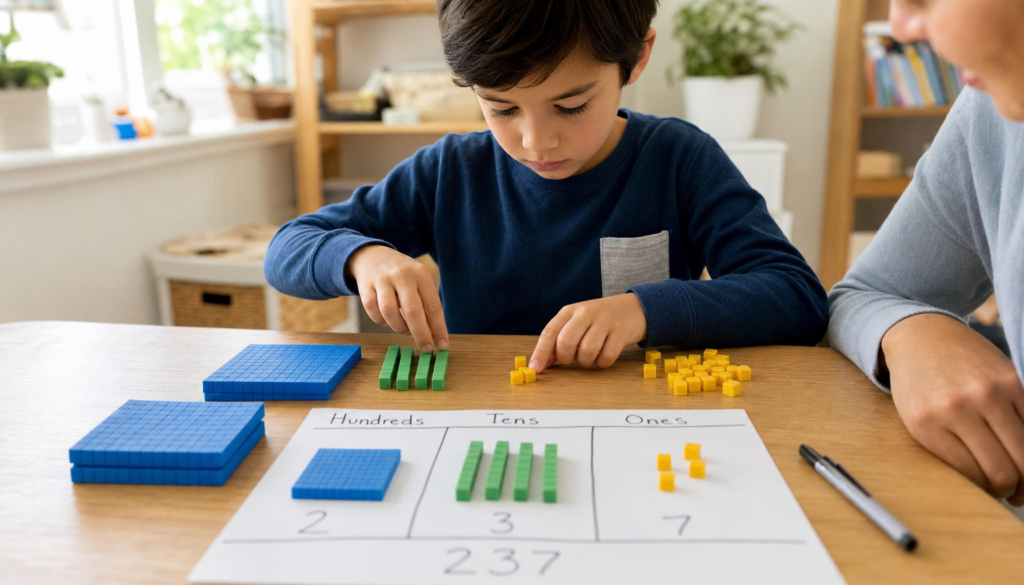
This is exactly the type of hands-on learning shown in our featured image. Instead of beginning with an abstract worksheet, the learner can physically construct the number and then connect that model to its written representation.
Build Numbers in More Than One Way
Once children understand the basic model, introduce an important discovery.
There is more than one way to represent a number.
Take 24.
The most obvious representation is:
2 tens + 4 ones.
But 24 can also be:
1 ten + 14 ones.
Or:
24 ones.
This prepares children for one of the most important ideas they will encounter later: regrouping.
A ten is not permanently locked into a tens rod. It represents ten individual ones grouped together.
Understanding that relationship makes addition and subtraction with regrouping far more logical.
Instead of memorizing mysterious instructions about “carrying” or “borrowing,” children understand that quantities can be regrouped without changing their total value.
Use a Place Value Chart
When teaching place value for kids, a simple chart can help connect the physical quantities children have been building with written numbers.
| Hundreds | Tens | Ones |
|---|---|---|
| 2 | 4 | 7 |
Ask the child to read the number.
Then connect each digit with its actual value:
2 hundreds = 200
4 tens = 40
7 ones = 7
Therefore:
200 + 40 + 7 = 247
This is called expanded form, and it provides another useful bridge between concrete quantities and written numbers.
Try reversing the process.
Give the child:
300 + 60 + 5
Ask the child to place each digit in the correct column.
The result is 365.
Moving in both directions helps strengthen understanding.
Ask “What Is the Value?” Instead of Only “What Is the Digit?”
This small change in wording can reveal whether a child truly understands place value.
Suppose the number is 482.
Ask:
“What digit is in the tens place?”
The answer is 8.
Then ask:
“What is the value of that 8?”
The answer is 80.
Those are two different questions.
A child who answers “8” to both may recognize the position but not yet understand the value represented by that position.
Practice questions such as:
“What is the value of the 5 in 352?”
“What is the value of the 7 in 174?”
“Which digit represents 600 in 641?”
These questions encourage children to think beyond simply identifying digits.
Compare Numbers Using Place Value
Place value also provides a logical way to compare numbers.
Suppose a child is comparing:
347 and 329.
Instead of teaching the child to rely only on a greater-than or less-than symbol, compare the numbers from the largest place value first.
Both numbers have three hundreds.
Next compare the tens.
347 has four tens.
329 has two tens.
Four tens are greater than two tens, so 347 is greater than 329.
There is no need to compare the ones.
This strategy becomes increasingly useful as numbers become larger.
Use Number Building Games
Place value practice does not always need to look like formal schoolwork.
Try giving a child three number cards.
For example:
2, 5, and 8.
Ask:
“What is the largest number you can make?”
“What is the smallest?”
Then ask why.
The child must think about which digit should occupy the hundreds, tens, and ones positions.
You can extend the activity:
“Make a number greater than 500.”
“Make a number between 700 and 800.”
“Make an odd number.”
“Put the 5 in the tens place.”
One set of number cards can generate many different place value activities.
Connect Place Value to Money
Money provides another familiar context for understanding groups and values.
Ten pennies equal one dime.
Ten dimes equal one dollar.
While money does not perfectly mirror every place value model, it can help children understand that the same total quantity can be represented in different forms.
For example, ten individual pennies can be exchanged for one dime without changing the total value.
That idea parallels regrouping ten ones into one ten.
Everyday situations can make abstract mathematics easier to understand because children see that grouping and exchanging quantities happen outside a workbook too.
Practice Finding Missing Values
Once the basic concept is established, try questions that require a little more reasoning.
For example:
4 hundreds + ___ tens + 3 ones = 473
The missing value is seven tens.
Or:
500 + 20 + ___ = 528
The missing value is eight ones.
You can also ask:
“What number has six hundreds, three tens, and nine ones?”
These activities encourage children to mentally construct numbers rather than simply recognize them.
Watch for Common Place Value Misunderstandings
Mistakes can provide useful clues about what a child does not yet understand.
A child might write “30052” when asked to combine 300 + 50 + 2.
That suggests the child may be joining the written symbols rather than combining their values.
Another child may say the 4 in 243 has a value of 4 instead of 40.
That child recognizes the digit but not its positional value.
These mistakes are not necessarily signs that the child needs more repetition of the same worksheet.
They may indicate that the learner needs to return to physical models, visual representations, or simpler numbers.
When an abstract concept becomes confusing, moving back to something concrete can often help.
Move From Concrete to Visual to Abstract
A useful progression for place value for kids is:
Concrete → Visual → Abstract
Concrete
The child physically handles base ten blocks, counters, sticks, or other objects.
Visual
The child uses drawings, place value charts, number lines, or pictures representing tens and ones.
Abstract
The child works confidently with written numbers and equations without needing physical models.
There is no need to rush through these stages.
Concrete materials are not merely for children who are struggling. They help learners develop the mental models that eventually make abstract mathematics easier.
Place Value Supports Addition and Subtraction
Strong place value understanding becomes especially important when children begin solving multi-digit addition and subtraction problems.
Children who need additional support can also benefit from these addition strategies for kids, which build understanding before emphasizing speed.
Consider:
27 + 15.
A child who understands place value can think:
20 + 10 = 30
7 + 5 = 12
Then:
30 + 12 = 42.
Or the child may recognize that 12 ones can be regrouped as one ten and two ones.
That gives:
3 tens + 1 ten + 2 ones = 42.
The traditional written algorithm becomes much more meaningful when children understand what is happening underneath it.
The same is true for subtraction.
When children understand that one ten can be decomposed into ten ones, regrouping becomes a logical mathematical operation rather than an arbitrary classroom procedure.
Place Value Continues Beyond Whole Numbers
Place value does not stop with hundreds or thousands.
The same structure continues as numbers become larger:
ones
tens
hundreds
thousands
ten thousands
hundred thousands
And eventually it extends in the other direction through decimals:
tenths
hundredths
thousandths
A learner who develops a strong understanding of place value early has a foundation for understanding much more advanced number concepts later.
That makes early place value instruction far more important than simply learning how to complete a particular worksheet.
Keep Practice Focused and Manageable
When practicing place value for kids, short, purposeful activities are usually more effective than long sessions filled with repetitive problems.
A ten-minute activity might include:
- Build three numbers with base ten blocks.
- Write each number.
- Say how many hundreds, tens, and ones it contains.
- Write one number in expanded form.
- Compare two of the numbers.
That is already substantial mathematical thinking.
On another day, use number cards.
Another day, use a place value chart.
Another day, use a worksheet.
Changing the representation while reinforcing the same underlying concept helps children understand the mathematics rather than memorize one particular activity format.
Help Children Explain Their Thinking
One of the best ways to check understanding is to ask a child to explain.
Instead of only asking:
“What is 63?”
Ask:
“How do you know this represents 63?”
A child might respond:
“Because there are six tens and three ones.”
That explanation provides much more information than the correct answer alone.
Other useful questions include:
“Can you build that number another way?”
“What does this digit represent?”
“What would happen if we added one more ten?”
“Which number is larger? How do you know?”
“Can you show me?”
These questions turn place value practice into mathematical reasoning.
Building a Strong Place Value Foundation
Place value for kids becomes easier when children can connect written digits to real quantities.
The goal is not merely for a learner to remember that the second position from the right is called the tens place. The goal is for the child to understand that a ten represents a group of ten ones, that ten tens can become one hundred, and that the position of a digit determines the quantity it represents.
Hands-on materials can make those relationships visible.
Place value charts organize them.
Expanded form expresses them mathematically.
Games provide additional practice.
Worksheets then reinforce ideas the child is beginning to understand.
When those pieces work together, place value becomes more than another elementary math topic. It becomes part of the number sense children will rely on throughout mathematics.
Keep Building Math Understanding
If your child is learning place value, focus first on understanding rather than speed. Give them opportunities to build numbers, break numbers apart, compare quantities, explain their reasoning, and practice the same idea in several different ways.
Continue Exploring Math Help & Guidance
Explore more Math Help & Guidance from Encouraging Math for practical strategies, teaching ideas, and clear explanations designed to make math easier to understand and practice.