
Every parent has watched a child struggle with something that seems simple, only to feel that pull to step in and fix it. What is easy to overlook is that problem solving skills for kids develop through experience and practice.
They are strengthened through repetition, trial, error, and the satisfaction of figuring things out independently.
When you immediately hand over a solution, your child may get past the problem, but they miss an opportunity to practice finding the answer themselves. When you give them room to wrestle with an appropriate challenge, they begin learning to trust their own thinking.
That distinction matters because the goal is not simply a perfectly completed homework sheet or a problem that disappears as quickly as possible.
The larger goal is raising a child who can look at a difficult or confusing situation, break it down, consider possibilities, and decide how to move forward.
Opportunities to practice are everywhere.
A lost library book, a disagreement over whose turn it is, a stubborn puzzle piece, or a forgotten lunchbox can all become opportunities for decision making and problem solving.
The key is recognizing these moments as useful learning experiences rather than inconveniences that always need to be smoothed over.
Your role does not have to be the answer key.
You can be the coach on the sideline, offering a thoughtful question or an occasional nudge while allowing your child to do the thinking.
When you guide instead of immediately fixing, you communicate an important message: You are capable, and I trust you to work through this.
This approach may not come naturally at first. Parents often solve problems because doing so is faster and easier, especially during a busy day.
But slowing down long enough to ask a thoughtful question can help children develop confidence in their own ability to handle challenges.
The Parent’s Role: Asking Questions Instead of Giving Answers
There is a reason the instinct to jump in and fix things can be so strong. Watching a child struggle naturally triggers a parent’s desire to help.
Stepping in too quickly, however, can prevent children from having the chance to work through the problem themselves.
Holding back does not mean refusing to help. It means changing the kind of help you provide.
Instead of immediately supplying the answer, try supplying a question.
A simple five-question framework can work in many everyday situations:
- What is the real problem here?
This helps children define the problem instead of simply reacting to it. - What are some ways you could handle it?
This encourages brainstorming and teaches children that there may be more than one possible solution. - What might happen if you try each one?
This helps children consider possible consequences before acting. - Which option seems like the best choice?
This puts the decision back into their hands. - How did it go?
This encourages reflection after they have tried a solution.
Suppose your child forgot their math homework at school. Instead of immediately deciding what should happen, begin by asking what the actual problem is.
Together, you might identify several possibilities. Your child could explain the situation to the teacher, contact a classmate to clarify the assignment, or decide how to handle the consequences the following day.
You can discuss what might happen with each choice without making the decision for them.
Once your child chooses a reasonable course of action and follows through, the final reflection question helps turn the experience into learning.
Every time you ask instead of automatically answering, you give your child another opportunity to practice thinking independently.
Step-by-Step Problem Solving in Everyday Situations
The five-step process may sound formal when written down, but it can become a natural part of everyday conversation.
You do not need to announce each step or turn a small problem into a lesson.
A few well-timed questions are often enough.
Consider a common situation: a missing homework sheet.
The first step is identifying what happened. Asking, “Where did you last see it?” encourages your child to retrace their actions.
Next comes brainstorming.
“What are some places we could look?”
Your child might suggest checking the backpack, looking in the car, checking the homework area, or contacting a friend.
At this stage, the objective is to generate possibilities rather than immediately judge each idea.
Then comes evaluation.
“Which of those options do you think we should try first?”
Now your child must think about which possibility is most likely to work.
Choosing comes next, and whenever appropriate, let the choice belong to your child.
Finally, reflect.
After the sheet is found, or even if it is not, ask:
“What worked well?”
“What would you do differently next time?”
Reflection is an important part of building problem solving skills for kids because children begin connecting their choices with what happened afterward.
The same process can be used in many situations.
During a sibling disagreement, ask, “What do you think the real problem is?” followed by, “What are some ways you could both handle it?”
During household chores, ask, “What needs to happen first?”
During a game, ask, “What choices do you have left?”
At first, your child may shrug and repeatedly answer, “I don’t know.”
Give them some time.
Learning to think through a problem takes practice. Silence does not always mean they cannot find an answer. Sometimes it means they are still working on one.
The more children experience this thinking process, the more familiar it becomes. Eventually, they can begin asking themselves the same kinds of questions without needing a parent to prompt every step.
That is when problem solving starts becoming a habit.
Age-Appropriate Activities to Strengthen Problem Solving Skills for Kids
Some of the best ways to develop problem solving skills for kids do not look like lessons at all.
They look like play.
The objective is not to drill children on logic. Instead, give them low-pressure challenges that require curiosity, experimentation, and some productive struggle.
For younger children, puzzles and simple logic activities can provide excellent practice.
A jigsaw puzzle requires a child to compare shapes, colors, and patterns while testing different possibilities. When a piece does not fit, they must adjust and try something else.
Simple board games can introduce turn-taking, planning, cause and effect, and learning to adjust when things do not go as expected.
When your child gets stuck, resist placing the puzzle piece or making the next move for them.
Ask:
“What clues could help you?”
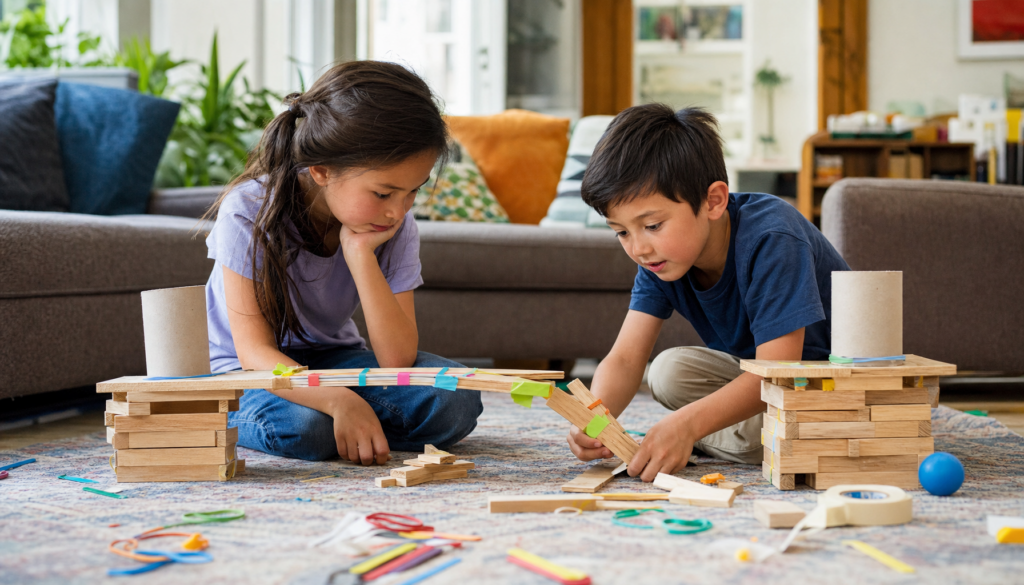
As children move further into elementary school, building challenges can become powerful problem-solving activities.
Give your child blocks, construction toys, craft sticks, cardboard, or other safe materials and present a challenge:
“Can you build a bridge that will hold this toy car?”
Now your child has to plan, build, test, and make adjustments.
The first design may collapse.
That does not mean the activity failed.
The collapse gives your child information. Something about the design did not work, so now they have an opportunity to figure out why and try again.
Older children can benefit from role-playing and “what would you do?” situations.
These work well during car rides, family meals, or other casual moments.
You might ask:
“What would you do if you got to school and realized you forgot something important?”
“What would you do if two friends were arguing?”
“What could you do if you had two things you wanted to buy but only enough money for one?”
These conversations allow children to practice decision making without facing immediate real-world consequences.
As children mature, include them in more genuine family decisions.
Ask them to help plan a meal within a budget, organize part of a family outing, compare prices for something they want, or figure out what supplies will be needed for a project.
Their solutions do not have to be perfect.
The act of considering options, evaluating possibilities, and making a decision provides valuable practice.
Building Confidence and Independence Through Manageable Mistakes
There is an important moment in a child’s development when they discover that they can make a mistake, deal with what happened, and try again.
Children who are allowed to make small, manageable mistakes have opportunities to learn that disappointment and frustration do not have to end the process.
A spilled glass of milk, a forgotten library book, or a lopsided cake they helped bake can all become learning experiences.
Persistence develops when children encounter a problem and discover they have tools for working through it.
Critical thinking develops when they consider what went wrong and what they could change.
Confidence grows when they successfully navigate an appropriate challenge with increasing independence.
This does not mean parents should allow children to make dangerous or unnecessarily costly mistakes. The objective is to create room for manageable consequences when the situation is safe and appropriate.
Sometimes one of the most useful things a parent can do is simply wait.
When your child encounters a minor difficulty, give them a few seconds before stepping in.
They may solve it themselves.
If they look to you for help, try offering a question before offering the solution:
“What do you think you could try next?”
That small pause creates space for independent thinking.
Over time, those moments can help children develop greater confidence in their own judgment.
Keeping the Momentum: Turning Practice Into a Habit
Like other skills, problem solving becomes stronger through repeated use.
You do not need to schedule formal problem-solving lessons every day. Instead, weave opportunities for thinking into normal family life.
At dinner, ask:
“What was one tricky thing that happened today, and how did you handle it?”
During chores, allow your child to decide which task should come first.
During a car ride, introduce an occasional “what would you do if…” question.
Games, puzzles, building activities, scavenger hunts, and family challenges can all provide additional practice.
For children who benefit from more structure, a problem-solving workbook can provide another way to practice. Activities that include scenarios, puzzles, logic challenges, choices, and open-ended questions can encourage children to apply different kinds of thinking.
The key is consistency rather than intensity.
A few minutes of thoughtful practice on a regular basis can be more useful than turning problem solving into another long assignment.
Some days your child will find a solution quickly. Other days they will need more guidance.
Both experiences count.
Every small problem your child works through, whether it involves a lost shoe, a difficult puzzle, a school assignment, or a disagreement with a friend, gives them another opportunity to practice thinking for themselves.
You do not need to have all the answers.
You need to ask useful questions, provide appropriate support, and give your child room to practice.
That is how problem solving skills for kids gradually become problem-solving skills they can carry into school, relationships, responsibilities, and everyday life.