
Learning addition is one of the first major transitions children make in mathematics.
For years, numbers have mostly been things to count. Five blocks means counting five objects. Eight crayons means identifying a group of eight. Then addition asks children to do something new: understand how quantities relate to one another and how they change when they are combined.
That transition can look deceptively simple to adults.
We see 6 + 3 and immediately think 9.
A first grader may see the same problem and wonder where to begin.
Should I count everything? Use my fingers? Draw dots? Start at six? Remember a fact? Use a number line?
The good news is that there is no single strategy every child must use. In fact, learning several first grade addition strategies can help children become more flexible thinkers and eventually choose efficient approaches for themselves.
The goal is not simply to get children to the correct answer.
It is to help them understand how they got there.
Why First Grade Addition Can Suddenly Feel Difficult
Many children understand informal addition long before they encounter equations.
Give a child three toy cars and then two more, and the child may easily determine there are five.
Put this on paper:
3 + 2 = ?
and the same child may hesitate.
What changed?
The mathematics did not change. The representation did.
Objects the child could see and touch have been replaced by numerals and symbols. The learner must understand that the written expression represents the same combining action that happened with the cars.
Strong early mathematics instruction emphasizes meaningful experiences that help young children develop mathematical understanding and reasoning.
This is why early addition benefits from a gradual transition:
Real objects → pictures and models → numbers and symbols
Children do not necessarily move through these stages once and leave each one behind. A learner may solve one problem mentally but need counters or a number line for another.
That is part of learning.
1. Counting On Builds From What a Child Already Knows
One of the most useful early addition strategies is counting on.
Consider:
6 + 3
A beginning learner might create a group of six objects and another group of three, then count all nine objects starting from one.
That works.
Counting on introduces a more efficient idea.
We already know the first number is six, so we do not need to recount it.
Start at six and count three more:
7, 8, 9
The answer is 9.
This may seem like a small change, but it represents important mathematical growth. The child is beginning to trust quantities rather than reconstructing them every time.
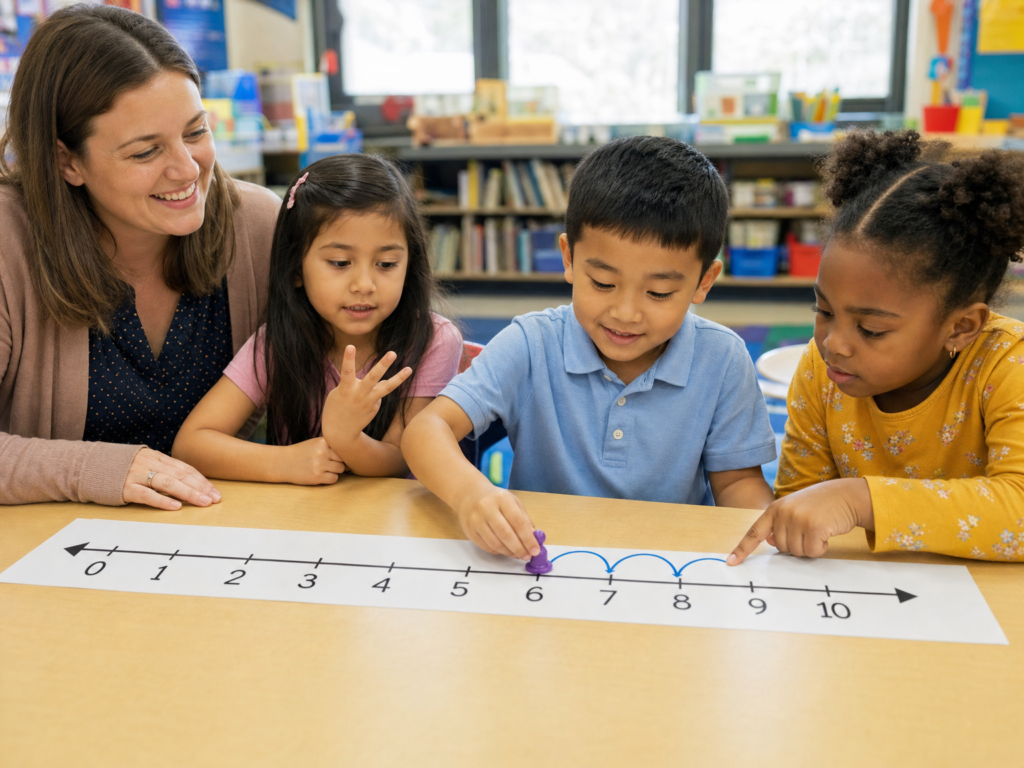
Try it with a number line
A number line makes counting on visible.
For 6 + 3:
Start at 6.
Move one space to 7.
Move another to 8.
Move one more to 9.
Three jumps have been made, so:
6 + 3 = 9
This is exactly why the number-line model is so useful. Children can see that addition moves a quantity forward.
2. Finger Counting Is a Tool, Not a Failure
Parents sometimes become concerned when children continue using their fingers for addition.
There is usually no reason to treat fingers as something children must immediately stop using.
Fingers provide a convenient physical representation of quantity. They allow a young learner to keep track of numbers while thinking through a problem.
Instead of saying:
“Don’t use your fingers.”
try asking:
“Can your fingers help you count on?”
Suppose the problem is:
7 + 4
The child can hold seven mentally and use four fingers to track:
8, 9, 10, 11.
Now the fingers are supporting a more advanced strategy rather than simply counting everything from one.
As children become more comfortable with number relationships, they often begin using mental strategies naturally.
The objective is not to remove supports as quickly as possible.
It is to help children need those supports less over time.
3. Doubles Give Children Useful Addition Anchors
Certain addition facts tend to become familiar quickly because they contain an obvious pattern.
These are doubles:
2 + 2 = 4
3 + 3 = 6
4 + 4 = 8
5 + 5 = 10
6 + 6 = 12
Once a child knows doubles, those facts can become anchors for nearby problems.
Suppose the child knows:
6 + 6 = 12
Now consider:
6 + 7
Instead of treating this as a completely new fact, ask:
“How is this different from 6 + 6?”
There is only one additional unit.
So:
6 + 6 = 12
12 + 1 = 13
Therefore:
6 + 7 = 13
This is called using a near double.
The child has used something already known to figure out something not yet automatic.
That is mathematical reasoning.
4. Making Ten Helps Children See Number Relationships
Ten is an especially useful landmark in our number system.
Children who know combinations that make ten can use those relationships to simplify other addition problems.
Start with:
1 + 9
2 + 8
3 + 7
4 + 6
5 + 5
These facts can be explored with ten-frames, counters, fingers, or simple drawings.
Once children recognize these combinations, they can begin using ten as a bridge.
Consider:
8 + 5
Eight needs two more to become ten.
The five can be separated into two and three.
So:
8 + 2 = 10
10 + 3 = 13
Therefore:
8 + 5 = 13
A child who understands this is doing much more than memorizing an addition fact.
The learner is decomposing numbers and recombining them in a useful way.
That flexibility becomes increasingly valuable as mathematics grows more complex.
5. Quick Drawings Can Make Abstract Problems Visible
Some children understand a problem better when they can represent it visually.
The drawing does not need to be elaborate.
For:
4 + 3
draw four dots:
● ● ● ●
Then three more:
● ● ●
Count the total.
Seven.
Dots, circles, tally marks, or simple lines can all work.
The purpose is not art. It is representation.
A quick drawing gives a child something concrete to examine when the numerals alone feel too abstract.
Over time, the learner may stop needing the drawing for familiar problems.
That is progress.
But while the visual representation is useful, it is doing exactly what it should.
6. Number Lines Turn Addition Into Movement
Some children respond especially well to number lines because addition becomes spatial.
Instead of thinking only about groups of objects, the child sees numbers as positions.
Suppose the problem is:
5 + 4
Place a finger or small marker on 5.
Move forward four spaces:
6
7
8
9
The answer is 9.
A number line also helps reinforce an important idea: the amount being added determines the number of jumps, not the number where the child lands.
That distinction can initially confuse young learners.
For 5 + 4, the child begins at 5 and makes four jumps.
The learner does not count the starting 5 as the first jump.
Hands-on practice can make that distinction much easier to understand.
7. Ten-Frames Help Children See Numbers Instead of Recounting Them
A ten-frame is a simple grid with ten spaces, usually arranged as two rows of five.
Its power comes from helping children recognize quantities visually.
Imagine seven counters in a ten-frame.
Rather than counting all seven individually, a child may begin recognizing:
“There are five on top and two more.”
Or:
“There are three empty spaces.”
Now consider:
7 + 5
The child can see that 7 needs 3 to fill the frame.
Break 5 into 3 and 2.
7 + 3 = 10
Then:
10 + 2 = 12.
The ten-frame makes the make-ten strategy visible.
Instead of asking a child to manipulate several numbers mentally before understanding the idea, the model shows exactly what is happening.
8. Real-Life Addition Gives the Symbols Meaning
Children encounter addition constantly outside formal math lessons.
Those moments are valuable because they connect equations to experiences.
At snack time:
“You have four crackers. If I give you two more, how many will you have?”
While playing:
“There are five cars in the box and three on the floor. How many cars are there altogether?”
While setting the table:
“We have three forks out. We need six. How many more should we get?”
While building:
“Your tower has seven blocks. What happens if you add two?”
These questions do not need to become formal lessons.
They simply reinforce the idea that addition describes something real.
Later, you can connect the situation to an equation.
Five cars plus three cars becomes:
5 + 3 = 8
The symbols now represent something the child already understands.
Parents looking for a broader overview can also explore our guide to addition for kids, including how addition develops from kindergarten through second grade
Which First Grade Addition Strategy Is Best?
There is no single set of first grade addition strategies that works best for every child.
Different problems naturally lend themselves to different strategies.
For:
8 + 2
making ten may be obvious.
For:
6 + 6
a doubles fact may be easiest.
For:
5 + 3
counting on may be efficient.
For an unfamiliar problem, a child might prefer a number line or drawing.
This is why teaching multiple strategies is useful.
We are not trying to make children perform unnecessary steps.
We are giving them options.
Eventually, an increasingly confident learner begins looking at a problem and deciding:
“I know a good way to solve this.”
That decision-making is an important part of number sense.
What Should First Grade Addition Practice Look Like?
More problems do not automatically create more learning.
Practicing first grade addition strategies does not require children to complete page after page of problems.
A young child can become overwhelmed by a worksheet crowded with dozens of equations, especially when the concept is still developing.
Early practice should make it easy to focus on the mathematics.
Look for:
- Clear layouts
- Readable numbers
- Adequate white space
- Room for drawing or working
- Problems appropriate to the child’s current skill
- Gradual increases in difficulty
- Opportunities to use different strategies
A child who understands six carefully selected problems may gain more than one who races through forty without thinking.
Practice has a purpose.
That purpose is not simply to finish the page.
Short, Consistent Practice Can Be Powerful
Young learners do not necessarily need long math sessions at home.
Short periods of focused practice can be easier to sustain and more productive.
One day you might practice counting on.
Another day, doubles.
Another day, make-ten combinations.
Then use a game or real-life activity.
This variety helps reinforce addition without making every encounter feel identical.
It also gives parents an opportunity to observe which strategies seem natural for the child and which ones need more support.
Ask Children to Explain How They Solved the Problem
One of the most valuable questions a parent or teacher can ask is:
“How did you figure that out?”
Suppose the problem is:
7 + 6
and the child answers 13.
The answer is correct, but the explanation tells you much more.
Perhaps the child says:
“I knew 6 + 6 was 12 and added one.”
That is near doubles.
Another child might say:
“I gave three of the six to seven so I could make ten. Then I had three left.”
That is making ten.
Another might say:
“I started at seven and counted six more.”
That is counting on.
All three children reached the same answer through valid reasoning.
When children explain their thinking, adults can see what they understand instead of evaluating only the final answer.
What Should You Do When the Answer Is Wrong?
A wrong answer is useful information.
Suppose a child says:
6 + 3 = 8
Rather than immediately supplying 9, ask:
“Show me how you got eight.”
The child may have started at six and counted:
6, 7, 8
instead of:
7, 8, 9.
Now you know the difficulty is not necessarily addition itself. The child may be counting the starting number as one of the three jumps.
A number line can make the correction clear.
Place the marker on 6.
Explain:
“We are already at six. We haven’t added anything yet.”
Then make three jumps:
This transforms a wrong answer into an opportunity to clarify the process.
Avoid Making Speed the Goal Too Early
Children eventually benefit from knowing many addition facts automatically.
Fluency makes later mathematics easier.
But speed and understanding are not the same thing.
A child who quickly guesses answers is not necessarily stronger mathematically than a child who takes a few extra seconds to reason accurately.
During the early stages, focus on questions such as:
“Which strategy could help?”
“Can you show me another way?”
“Does that answer make sense?”
“What number did you start with?”
“How many jumps did you make?”
As understanding becomes stronger and children encounter the same relationships repeatedly, many facts become easier to recall.
Fluency can grow from understanding rather than competing with it.
Be Careful With the Language You Use Around Math
Children notice how adults talk about mathematics.
Statements such as:
“I was never good at math.”
or:
“Math was always hard for me.”
may sound harmless, but young children can interpret them as evidence that mathematical ability is something people either have or do not have.
Instead, emphasize learning.
“You haven’t learned that strategy yet.”
“Let’s find a way to make this easier to see.”
“Show me what you already understand.”
“You tried another strategy when the first one didn’t work.”
The message is not that every problem should feel easy.
The message is that difficulty can be worked through.
When Should Parents Talk With the Teacher?
If a child consistently struggles with addition despite appropriate practice, communication with the teacher can be very helpful.
Ask specific questions.
Instead of:
“Is my child bad at math?”
try:
“Which addition strategies are you using in class?”
“Is my child comfortable counting on?”
“Are students working with ten-frames or number lines?”
“Which addition facts should children currently be practicing?”
“Is there a particular skill you think we should reinforce at home?”
This helps home practice complement classroom instruction rather than accidentally introducing conflicting approaches.
Parents and teachers do not need to use identical activities.
But understanding what the child is currently learning makes home support much more purposeful.
Help Children Discover That There Is More Than One Way
One of the most important lessons in early mathematics is that a problem can often be approached in several ways.
Take:
8 + 7
A child could count on seven spaces from eight.
Another could think:
7 + 7 = 14, plus one = 15.
Another could make ten:
8 + 2 = 10, with 5 remaining, so 15.
All lead to the same answer.
A child who understands several approaches is not simply collecting tricks.
The learner is developing flexibility with numbers.
That flexibility becomes the foundation for increasingly sophisticated mental math.
The best first grade addition strategies help children understand relationships between numbers rather than simply memorize answers.
First Grade Addition Strategies Should Build Understanding
The purpose of early addition is not to produce a child who can complete the greatest number of problems in the shortest time.
It is to help children understand how numbers work together.
Counting on teaches children to build from a known quantity.
Fingers provide a physical tool for keeping track.
Doubles create useful anchors.
Making ten develops number flexibility.
Drawings turn abstract numbers into visible quantities.
Number lines represent addition as movement.
Ten-frames reveal relationships to ten.
Everyday situations show children why addition matters.
Together, these first grade addition strategies help children move from counting individual objects toward reasoning about numbers.
And eventually something important begins to happen.
The child sees a problem and no longer asks:
“What am I supposed to do?”
Instead, the learner begins thinking:
“I know a way to figure this out.”
That is a much more valuable foundation than memorizing an answer without understanding why it works.
Frequently Asked Questions
What addition strategy should a first grader learn first?
Concrete objects and counting on are excellent starting points. Children should first understand that addition combines quantities. Once that concept is secure, counting on helps them move toward more efficient mental calculation.
Is finger counting okay in first grade?
Yes. Fingers can help children keep track of quantities while developing number sense. Rather than prohibiting them, gradually introduce strategies such as counting on, doubles, and making ten.
When should children learn the make-ten strategy?
Introduce making ten after children are comfortable with basic counting and simple addition and are beginning to recognize combinations that make ten. Readiness matters more than a particular date in the school year.
How many addition problems should a first grader practice?
There is no magic number. A short set of thoughtfully chosen problems can be more useful than a crowded page of repetitive calculations. Focus on accuracy, reasoning, and consistent practice rather than volume.
Should first graders memorize addition facts?
Children should gradually develop fluency with basic addition facts, but memorization should accompany understanding. Strategies give children ways to reconstruct an answer when a fact is not immediately recalled.
What if my child uses a different strategy than the one I learned?
That can be perfectly appropriate. Ask the child to explain the strategy. If the reasoning is mathematically sound and the child understands it, a different method is not automatically a problem.
Continue Exploring Math Help & Guidance
Explore more Math Help & Guidance from Encouraging Math for practical strategies, teaching ideas, and clear explanations designed to make math easier to understand and practice.