

Multiplication fluency can become frustrating when a learner practices regularly but still hesitates over basic facts. Building stronger recall takes more than simply completing more problems. Learners need consistent, focused practice that helps multiplication and division facts become familiar and easier to recall.
When multiplication facts require significant effort every time they appear, more advanced math can quickly become frustrating. The goal is not simply speed. It is helping learners develop enough confidence and automatic recall that they can focus their attention on the larger problem in front of them.
With the right approach, multiplication and division practice can become manageable, predictable, and much less stressful.
Why Multiplication and Division Fluency Matters
Fluency in multiplication and division is not about memorization alone. It helps free up mental energy for more complex mathematical thinking.
Consider a learner working through a multi-step word problem. If they must stop and work out a basic fact such as 7 × 8 each time it appears, much of their attention is spent on the calculation rather than understanding the larger problem.
As basic facts become more familiar, learners have more mental capacity available for fractions, ratios, algebra, measurement, word problems, and other concepts that depend on multiplication and division.
This is why focused practice still has an important place in math learning.
The objective is not to pressure a learner into answering as quickly as possible. Instead, we want basic facts to become increasingly familiar until answers can be recalled accurately and confidently.
Build Fluency Through Layered Practice
Building multiplication fluency does not have to begin with a page filled with random problems.
A more manageable approach is to build skills gradually.
Learners can begin with familiar patterns such as the 2s, 5s, and 10s. These facts often provide an accessible starting point and can help build early confidence.
From there, practice can expand into other fact groups and useful relationships.
Square facts such as 3 × 3, 4 × 4, 6 × 6, and 8 × 8 can become helpful reference points. A learner who knows that 6 × 6 = 36, for example, may begin recognizing that 6 × 7 is simply one additional group of six.
That is an important shift.
The learner is no longer treating every multiplication fact as an isolated piece of information. They are beginning to see relationships between numbers.
Connect Multiplication and Division
Multiplication and division are closely related, so practice becomes more meaningful when learners see those connections.
Stronger multiplication fluency can also make division easier because learners begin recognizing the related facts more quickly.
If a learner knows:
7 × 8 = 56
they can use that knowledge to understand:
8 × 7 = 56
56 ÷ 7 = 8
56 ÷ 8 = 7
Fact-family practice makes these relationships visible.
Instead of asking learners to memorize multiplication and division as two completely separate sets of facts, we can help them understand how the operations work together.
This can make division feel considerably less intimidating.
A learner who understands the multiplication fact behind a division problem already has a strategy for finding the answer.
What Makes a Helpful Multiplication Practice Worksheet?
More problems do not automatically create better practice.
A worksheet should make it easy for the learner to focus on the mathematical skill being practiced.
Clear formatting, appropriate spacing, manageable problem sets, and a focused objective can all help.
A learner practicing the 7s, for example, may benefit more from concentrated practice with those facts than from immediately working through a large collection of unrelated multiplication problems.
The amount of work matters too.
A shorter worksheet that a learner completes successfully can be more productive than a large page that creates frustration before practice even begins.
White space and uncluttered formatting can also make a meaningful difference. When the page looks manageable, learners can concentrate on solving problems rather than trying to navigate a crowded layout.
The goal is simple:
Make practice clear enough that the learner can focus on learning.
Build Fluency Without Creating Burnout
Repetition is important, but repetition does not have to mean long practice sessions.
Short, consistent practice can be very effective.
Ten focused minutes several times during the week may be easier for a learner to sustain than one long practice session.
Practice formats can also vary while reinforcing the same underlying skills.
For example, learners might rotate among:
- standard multiplication problems
- missing-factor problems
- multiplication and division fact families
- mixed fact review
- short fluency practice
- verbal fact practice
The mathematical objective remains consistent while the activity changes enough to keep practice from feeling monotonous.
Most importantly, progress should be measured against the learner’s own previous performance.
Different learners develop fluency at different rates. The purpose of practice is improvement, not comparison.
Find the Multiplication Facts That Need More Practice
Many learners develop multiplication fluency unevenly, mastering some fact groups much sooner than others.
They may know the 2s, 5s, and 10s immediately while consistently hesitating on the 6s, 7s, or 8s.
When that happens, repeatedly practicing facts the learner already knows may not be the best use of practice time.
Instead, look for patterns.
Which facts are consistently incorrect?
Which answers require noticeably more time?
Which fact families cause the most hesitation?
Those are the areas where focused practice can help most.
For example, a learner struggling with the 8s can practice the sequence:
8, 16, 24, 32, 40, 48, 56, 64…
Saying the sequence aloud, writing it, and then applying it to multiplication problems provides several ways to reinforce the same number pattern.
Use Missing-Factor Problems to Strengthen Understanding
Traditional multiplication practice usually provides two factors:
9 × 4 = ?
But another useful format reverses the thinking:
9 × ? = 36
Now the learner has to identify the missing factor.
This type of practice can help strengthen the connection between multiplication and division because the learner is working backward from the product.
Once learners become comfortable moving in both directions, fact relationships begin to make more sense.
That understanding can eventually become more valuable than memorizing isolated answers.
Choosing Multiplication and Division Practice Resources
Parents and homeschool families often need math resources that are easy to use.
Practice materials should not require complicated preparation before learning can begin.
Printable worksheets can be especially convenient because they can be downloaded, printed, and used when needed.
When choosing practice materials, look for resources that:
- focus clearly on a particular skill
- provide enough practice without overwhelming the learner
- progress logically
- use readable, uncluttered layouts
- include answer keys when appropriate
- connect related mathematical ideas
- allow learners to build confidence gradually
Skill level is often more useful than the grade printed on the page.
A learner may be working at grade level overall while still needing additional practice with a particular foundational skill. Providing that practice is not moving backward. It is strengthening the foundation needed for what comes next.
When Should You Use Timed Multiplication Practice?
Timed practice can have a place in fluency development, but timing should not replace learning.
If a learner is still working out multiplication facts or relying heavily on counting strategies, adding a timer may create unnecessary pressure.
First focus on accuracy and understanding.
Once facts become familiar, occasional short fluency checks can help you see which facts are becoming automatic and which still need attention.
Keep these sessions brief and low pressure.
The timer should provide information, not become a judgment of the learner’s mathematical ability.
For a learner who becomes anxious when timed, untimed practice can still provide valuable fluency development.
Why Fact Families Can Make Division Easier
Learners sometimes approach division as though they are starting an entirely new subject.
Fact families help show that much of what they need is already familiar.
Consider:
6 × 9 = 54
From this one relationship, learners can explore:
9 × 6 = 54
54 ÷ 6 = 9
54 ÷ 9 = 6
This same relationship appears in word problems.
If 54 objects are divided equally among 6 groups, understanding the related multiplication fact provides a direct route to the answer.
Fact-family practice helps learners see these connections repeatedly until multiplication and division begin to feel like related ways of working with the same numbers.
Create a Simple Multiplication Fluency Routine
A simple multiplication fluency routine can make regular practice easier for both learners and parents.
You do not need an elaborate system to help a learner strengthen multiplication skills.
Try a simple routine:
1. Identify one area that needs practice.
Choose a particular fact group or small collection of difficult facts.
2. Practice for a short period.
Keep the session manageable and focused.
3. Mix familiar and developing facts.
Give the learner opportunities to experience success while continuing to work on weaker areas.
4. Connect multiplication with division.
Use fact families to reinforce both operations.
5. Review progress regularly.
Notice which facts have become easier and adjust the next practice session accordingly.
Small amounts of focused practice can add up considerably over time.
Printable Multiplication and Division Practice
Encouraging Math offers printable resources designed to help learners strengthen important math skills through clear, focused practice.
Rather than searching for another random worksheet every time a learner needs practice, you can choose resources organized around the skill you are working to strengthen.
For multiplication and division practice, explore:
Multiplication Facts Practice Worksheets 1–12
Build confidence with focused multiplication fact practice.
Times Tables Fluency Practice Worksheets 1–12
Build stronger multiplication fact recall through focused fluency practice.
Division Facts Practice Worksheets 1–12
Reinforce division facts with structured printable practice.
Division Fluency Practice Worksheets 1–12
Give learners additional opportunities to strengthen division recall.
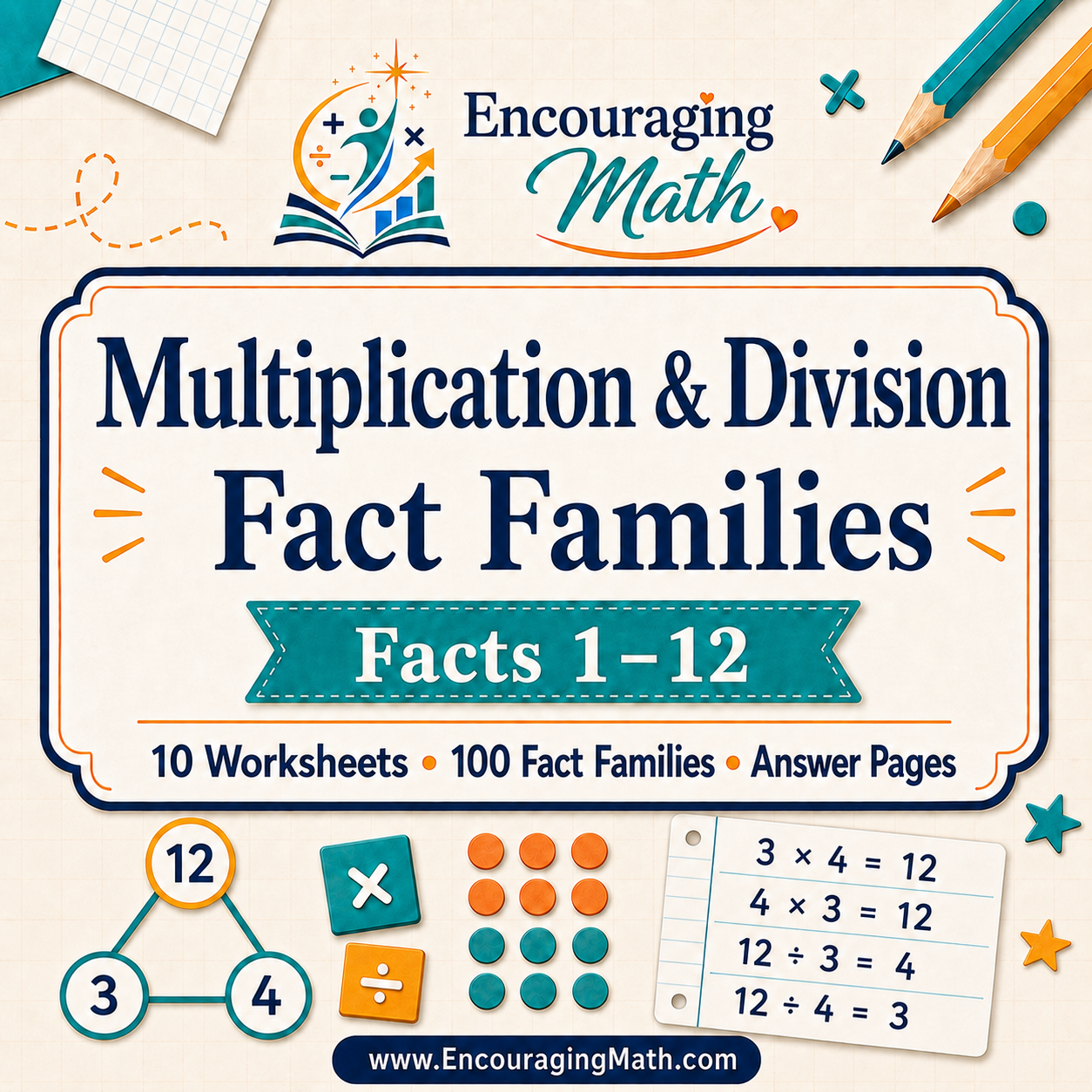
Multiplication & Division Fact Families Practice Worksheets
Help learners see how multiplication and division facts connect.
These should become internal links to the corresponding Encouraging Math product pages once the article is placed in WordPress.
Frequently Asked Questions
How long does it take to build multiplication fluency?
There is no single timeline that applies to every learner. Progress depends on previous knowledge, practice frequency, learning needs, and the particular facts being practiced. Short, consistent sessions can provide learners with repeated opportunities to strengthen recall without making practice overwhelming.
Should I use timed tests for multiplication and division practice?
Timed practice is best treated as an optional way to check developing fluency rather than the primary way to teach multiplication facts. Accuracy and understanding should come first. Once facts are familiar, brief timed activities may help identify which facts have become automatic and which need additional practice.
What if my child keeps forgetting the same multiplication facts?
Focus specifically on those facts rather than repeatedly reviewing everything. Look for number patterns, related facts, skip-counting sequences, fact families, and other connections that can make the difficult facts easier to understand and remember.
How many problems should be on a worksheet?
There is no ideal number for every learner. The worksheet should provide enough repetition to reinforce the skill without creating unnecessary fatigue or frustration. A shorter page completed with concentration is often more useful than a much longer page a learner struggles to finish.
Can worksheets alone build multiplication and division fluency?
Worksheets can provide valuable focused practice, but they do not have to be the only approach. Verbal practice, number patterns, fact families, games, real-world examples, and other activities can reinforce the same skills. The most useful combination is one that provides consistent practice while keeping the learner engaged.
One Skill at a Time
Multiplication and division fluency does not have to happen all at once.
One fact family becomes easier. Then another.
Hesitation gradually decreases. Patterns become more familiar. Division begins connecting naturally with multiplication.
That is real progress.
Give learners clear practice, enough repetition, and room to develop at their own pace.
Start with the skill your learner needs today and build from there.
Continue Exploring Math Help & Guidance
Explore more Math Help & Guidance from Encouraging Math for practical strategies, teaching ideas, and clear explanations designed to make math easier to understand and practice.